
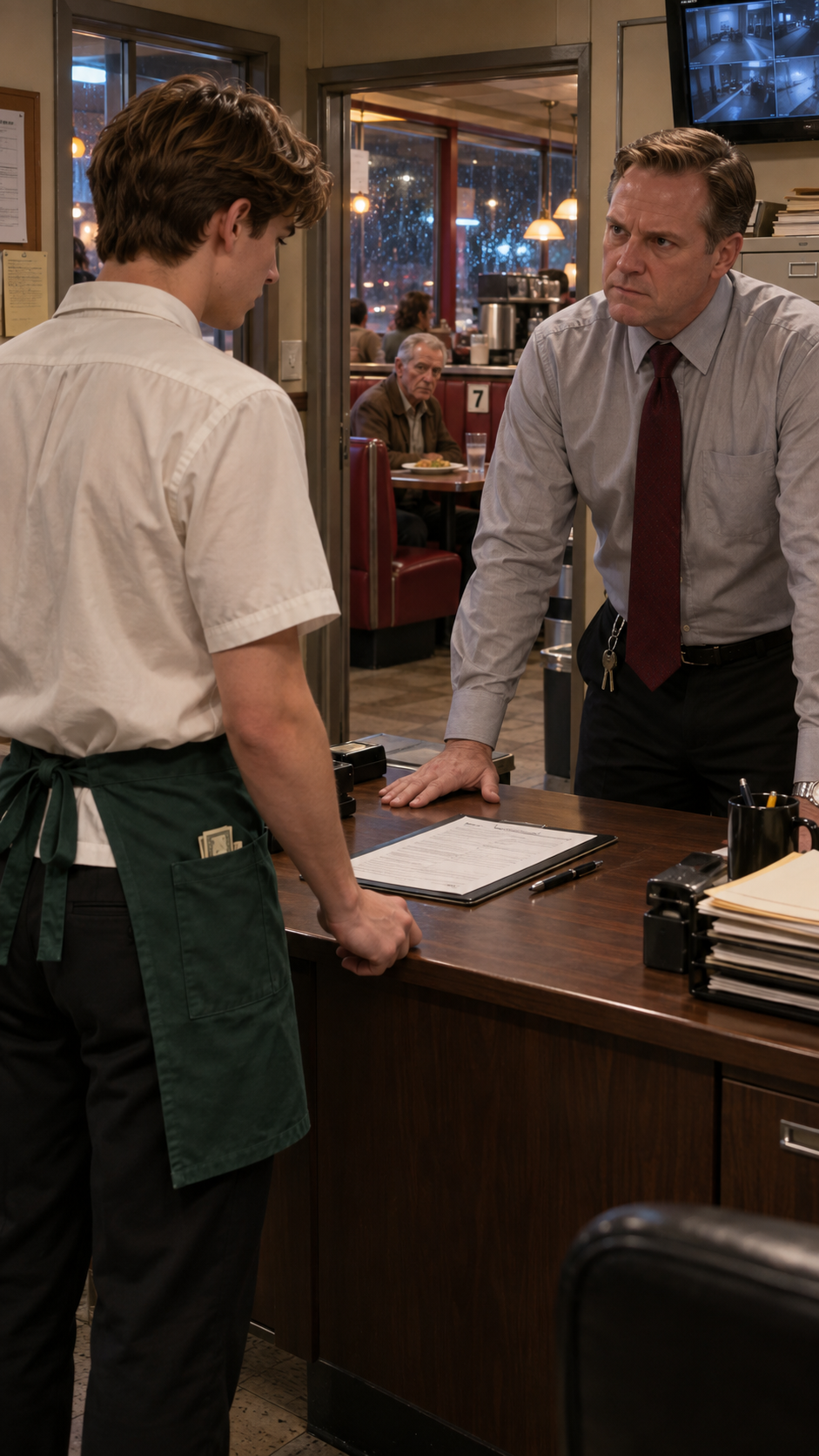
CHAPTER 5 – PART 5 – THE MAN IN BOOTH SEVEN — I Was Fired for Buying Him Dinner
PART 5: The Lesson Dale Got Wrong
I arrived home after midnight.
The apartment was dark except for the kitchen light.
My mother was sitting at the table.
She wore her pharmacy sweater over pajamas and had a mug of tea between her hands.
The moment I walked inside, she looked at my clothes.
“Why are you soaked?”
I dropped my backpack.
“Long story.”
Her eyes moved toward my waist.
“Where’s your apron?”
That was the problem with mothers.
They noticed the detail you hoped to hide first.
I sat across from her.
“I got fired.”
Her face changed.
“What?”
“Maybe temporarily.”
“That is not better.”
“It gets complicated.”
“Jake.”
“I bought an old man dinner.”
She stared at me.
I told her everything.
The rain.
Booth seven.
The wallet.
The fourteen dollars.
Dale.
The office.
The termination form.
Frank’s phone call.
The SUVs.
Mercer Dining.
When I finished, my mother had both hands over her mouth.
“You bought the owner of the company meatloaf?”
“I didn’t know he was the owner.”
“That’s the part you’re focusing on?”
“I’m tired.”
She leaned back.
Then she started laughing.
Not politely.
Not quietly.
She laughed until tears appeared in her eyes.
I stared at her.
“I lost my job tonight.”
“You might have accidentally gotten your manager fired.”
“He’s suspended.”
“That is somehow even stranger.”
I started laughing too.
The exhaustion finally broke through everything else.
For nearly a minute, we sat in our tiny kitchen laughing at the absurdity of it.
Then my mother became serious.
“You spent fourteen dollars.”
“I knew we’d get to that part.”
“You had twenty-six.”
“Yes.”
“You needed gas.”
“Yes.”
She looked toward the counter where the overdue electric bill sat beneath a magnet.
I waited.
Then she reached across the table and squeezed my hand.
“Your father would have done the same thing.”
That hurt.
Not badly.
Just deeply.
“I know.”
“He used to give away money we didn’t have.”
“I remember.”
“It drove me crazy.”
“I remember that too.”
She smiled.
Then her eyes filled.
“But sometimes the world needs people who do things that make practical people crazy.”
I looked down at our hands.
“Dale said the world doesn’t reward emotional decisions.”
My mother snorted.
“Dale sounds exhausting.”
“He is.”
“You didn’t buy dinner because you expected a reward.”
“No.”
“Then whether the world rewarded it is irrelevant.”
That might have been the most important thing anyone said to me that night.
The next morning, Elena called at eleven twenty-three.
She told me the termination had been formally rescinded.
My employee record would show no disciplinary action.
I would receive pay for the hours I had been scheduled during the review.
I could return for my Thursday shift.
Then she asked if I would provide a written statement about previous scheduling practices at location seventeen.
I agreed.
Melissa did too.
So did Luis.
Then Brianna.
Then two former employees.
What happened after that was not dramatic.
No police arrived.
Nobody went to court.
There was no hidden crime beneath Harrison’s Roadside Grill.
There was only a pattern of bad leadership that people had tolerated because each person assumed they were the only one experiencing it.
Dale had cut hours after disagreements.
He had threatened employees with worse sections.
He had ignored portions of the company’s progressive discipline policy.
He had used phrases like “people like that” before.
None of those things alone produced a movie-style revelation.
Together, they explained exactly why an eighteen-year-old server could be fired for buying a paid meal.
A week after the review began, Dale Hargrove was terminated from Harrison’s Roadside Grill.
Frank did not call me to announce it.
Elena did.
She did not celebrate either.
“Employment decisions aren’t trophies,” she told me.
I respected that.
Dale had bills too.
Maybe a family.
Maybe fears I knew nothing about.
Losing his job did not make me happy.
What mattered was that he could no longer use it to make everyone else afraid.
The company brought in an interim manager named Carla Reynolds from another Columbus location.
She was not perfect.
She was not endlessly cheerful.
She still got angry when servers forgot side work.
She still expected us to show up on time.
She once made me clean beneath every booth because I tried to convince her the closing crew had already done it.
But when she corrected people, she explained why.
When someone disagreed, she listened.
When schedules changed, there was a reason.
Within a month, Harrison’s felt different.
Not magical.
Just normal.
I had never realized how valuable normal could be.
Frank did not appear again immediately.
That surprised me.
Part of me assumed he would suddenly become a regular customer.
Maybe every Tuesday he would sit in booth seven and order meatloaf.
Real life was less tidy.
Frank Mercer ran a company with restaurants in several states.
I went back to carrying coffee, sweeping floors, and asking strangers whether they wanted fries.
For weeks, I wondered if that night had mattered to him as much as it mattered to me.
Then an envelope arrived at the restaurant.
My name was handwritten on the front.
Inside was a community-college application.
No check.
No scholarship.
No golden ticket.
Just the application.
A yellow sticky note was attached.
It contained one sentence.
YOU SAID NUMBERS MAKE SENSE, SO GO LEARN MORE OF THEM.
F.M.
I laughed so loudly Carla came out of the office.
“What?”
I showed her.
She read it.
“Are you going to apply?”
“I guess Frank thinks I should.”
“That isn’t what I asked.”
I looked at the application.
For months, I had used money as the reason I could not begin.
Money was a real problem.
But it was not the only problem.
I was scared.
Scared I would enroll and fail.
Scared I would spend money we needed elsewhere.
Scared my mother would struggle without my extra shifts.
Scared I would discover everyone else knew things I did not.
Waiting felt safer because waiting could always be described as responsibility.
That night, I took the application home.
My mother put it on the kitchen table.
“Fill it out.”
“We need money.”
“We always need money.”
“My hours—”
“We’ll figure out your hours.”
“Mom.”
“Jake.”
I stared at her.
She pointed at the form.
“Fill it out.”
So I did.
I enrolled the following semester in two evening classes.
Introduction to Business.
College Algebra.
Nothing glamorous.
Nothing cinematic.
I continued working at Harrison’s.
I worked fewer shifts.
We struggled a little more for several months.
I also discovered that being tired in a classroom felt different from being tired behind a register.
One kind of tired felt like surviving.
The other felt like moving.
Frank visited location seventeen again in March.
This time the weather was clear.
He walked through the door wearing the same brown jacket.
Carla recognized him immediately.
So did every employee.
Someone in the kitchen whispered, “Mercer’s here.”
Frank heard.
He frowned.
“Please don’t do that.”
He walked toward booth seven.
I grabbed a menu.
“Water?”
“Yes.”
“Anything else?”
He studied the menu dramatically.
“How much is the vegetable soup after tax?”
I laughed.
“Very funny.”
He smiled.
“Meatloaf.”
“With mashed potatoes?”
“Obviously.”
“Green beans?”
“I’m beginning to suspect you aren’t a trained server.”
“Roll?”
“Two if your standards permit.”
I rang in his food.
When I returned, he nodded toward the seat across from him.
“College?”
“Started.”
“How bad?”
“Algebra should be illegal.”
“Accounting?”
“Next semester.”
He nodded.
“Your mother?”
“Still telling me I work too much.”
“Good woman.”
“You’ve never met her.”
“I’ve heard enough.”
I sat for another minute.
Then I asked the question I had carried since November.
“Why did that dinner matter so much to you?”
Frank looked toward the window.
For several seconds, he did not answer.
Then he touched the edge of his old jacket.
“When I was twenty-one, I worked nights at a hotel restaurant.”
I waited.
“I had a manager who knew exactly which customers mattered.”
He made quotation marks with his fingers around the final word.
“If someone arrived in an expensive coat, he personally greeted them.”
Frank looked down at his sleeves.
“If someone looked poor, he sent them toward the counter even when dining-room tables were empty.”
“That sounds familiar.”
“It was.”
His expression became distant.
“One night, a woman came inside with two children.”
I said nothing.
“She had enough money for one plate of spaghetti.”
Frank’s fingers tightened around the coffee cup.
“She ordered it and divided it between the children.”
“What did you do?”
“I brought bread.”
“For free?”
“Yes.”
“Did you get fired?”
“No.”
He gave a sad smile.
“I was too afraid to do anything bigger.”
That surprised me.
“You?”
“I was twenty-one.”
“You started restaurants.”
“Later.”
Frank looked directly at me.
“That night, I watched those children eat bread while their mother drank water.”
Something heavy settled in his expression.
“I remembered them for fifty years.”
I understood then.
The dinner had not created Frank’s beliefs.
It had reopened something old.
“Did your manager know?”
“He knew.”
“What happened?”
“Nothing.”
Frank’s answer was immediate.
“That was the part I regretted.”
“You couldn’t control him.”
“No.”
“But I could control myself.”
He looked around Harrison’s.
“When I started building restaurants, I promised myself no customer would be measured by clothing, age, accent, wallet, or appearance.”
He sighed.
“Companies grow.”
“People forget.”
“Exactly.”
I thought about Dale.
“So you blamed yourself?”
Frank shook his head.
“For Dale?”
“No.”
“For letting the company become large enough that I assumed values could live inside a handbook.”
That sentence stayed with me.
Frank leaned back.
“You taught me something too.”
I laughed.
“I bought you meatloaf.”
“No.”
“You reminded me values exist only when somebody chooses them while the decision costs something.”
I stopped smiling.
“For you, kindness cost fourteen dollars.”
He nodded.
“For Dale, fairness would have cost him nothing.”
I thought about that difference.
It was almost ridiculous.
The person with less had given more.
Not because I was better than Dale.
I was not.
I had been selfish plenty of times.
Impatient.
Angry.
Judgmental.
I had walked past people who needed help because I was tired or busy or afraid.
But on one rainy Tuesday, I had made one decision.
That decision changed my life.
Not because Frank Mercer was rich.
Not because black SUVs arrived.
Not because Dale lost his job.
It changed my life because I learned exactly what kind of person I wanted to be before I knew whether being that person would benefit me.
Frank finished his meal.
This time it was still warm.
He placed cash on the table.
I looked down.
Twenty dollars.
The bill was eighteen and change.
“You forgot the tip.”
He raised an eyebrow.
“Check underneath.”
I lifted the twenty.
Two more dollars sat below it.
“Twenty-two dollars?”
“Approximately twenty percent.”
“You own restaurants and you tip twenty percent?”
“Should I tip less?”
“I expected a dramatic hundred-dollar bill.”
Frank looked offended.
“That would destroy your character.”
I laughed.
He stood.
At the entrance, he stopped.
“Jake.”
“Yeah?”
“When somebody tells you kindness is bad business, remember something.”
“What?”
Frank looked around the dining room.
“Businesses are made of people before they are made of numbers.”
Then he left.
Years have passed since that night.
I eventually completed an associate degree.
Then I transferred.
I studied accounting after all.
My mother still tells people the story differently than I do.
According to her, I nearly bankrupted the family buying meatloaf for a millionaire.
According to Melissa, I accidentally launched a corporate investigation with mashed potatoes.
According to Frank, I taught a seventy-three-year-old chairman something he should have remembered on his own.
None of those versions feels completely right.
The truth is simpler.
A hungry old man walked into a roadside diner during a November storm.
He looked tired.
He looked poor.
Nobody knew his name.
Nobody knew what he owned.
Nobody knew three SUVs would soon arrive.
Nobody knew that an entire management team would be standing in the dining room before midnight.
And none of that mattered when the decision had to be made.
He was hungry.
I had twenty-six dollars.
Dinner cost fourteen.
So I bought it.
For a long time, people who heard the story focused on the reveal.
“Can you believe the old man owned the company?”
“Can you believe Dale fired you in front of the chairman?”
“Can you believe Frank Mercer was sitting in booth seven?”
I understand why.
The reveal makes a better story.
But it is not the part I remember most.
I remember Frank asking what he had done to deserve my money.
I remember Dale saying “people like that.”
I remember staring at the termination paper and knowing exactly how badly I needed the job.
I remember walking into the rain with twelve dollars in my pocket.
Those moments mattered because nobody knew what would happen next.
Kindness is easy when you know there is a reward waiting behind it.
Courage is easy when the powerful person is already standing beside you.
Respect is easy when someone has a title printed beneath their name.
The real test comes earlier.
It comes when the person in front of you appears to have nothing to offer.
Dale believed importance determined how much respect somebody deserved.
He treated Frank one way when he saw an old man in a wet jacket.
He treated him differently the second he heard the name Mercer.
That was why Frank never considered Dale’s failure to recognize him the real mistake.
Dale’s mistake was believing recognition should have mattered at all.
I still think about booth seven sometimes.
I think about how close I came to walking past it.
How easy it would have been to refill Frank’s water, smile politely, and leave him hungry.
Nobody would have blamed me.
I needed the money.
I had bills.
I had responsibilities.
I was eighteen.
There were a hundred reasonable excuses.
But my father used to say something my mother reminded me of years later.
He said character rarely announces itself with a huge decision.
Most of the time, it arrives disguised as something small.
Holding a door.
Making a phone call.
Staying five minutes.
Sharing a meal.
Giving somebody dignity when nobody important appears to be watching.
That night, somebody important happened to be watching.
But I did not know that.
And that is why it mattered.
If Frank Mercer had actually been a broke old man named Frank with nowhere important to go and nobody important to call, I would still want to believe I would have bought him the same dinner.
Because the best thing that happened to me that rainy Tuesday was not getting my job back.
It was not meeting a powerful businessman.
It was not seeing black SUVs in the parking lot.
It was not watching Dale lose the authority he had used against me.
The best thing that happened was discovering that, even when I was scared and broke and had something real to lose, I could still choose what kind of person I wanted to be.
Frank once told me small kindness was not worthless.
He was right.
Sometimes fourteen dollars and eighteen cents can buy a plate of meatloaf.
Sometimes it can save a hungry man from going to bed without dinner.
And sometimes, without anyone realizing it yet, it can expose exactly who everyone in the room really is.
Leave a Reply