
CHAPTER 2 – PART 2 – THE MAN IN BOOTH SEVEN — I Was Fired for Buying Him Dinner
PART 2: People Like That
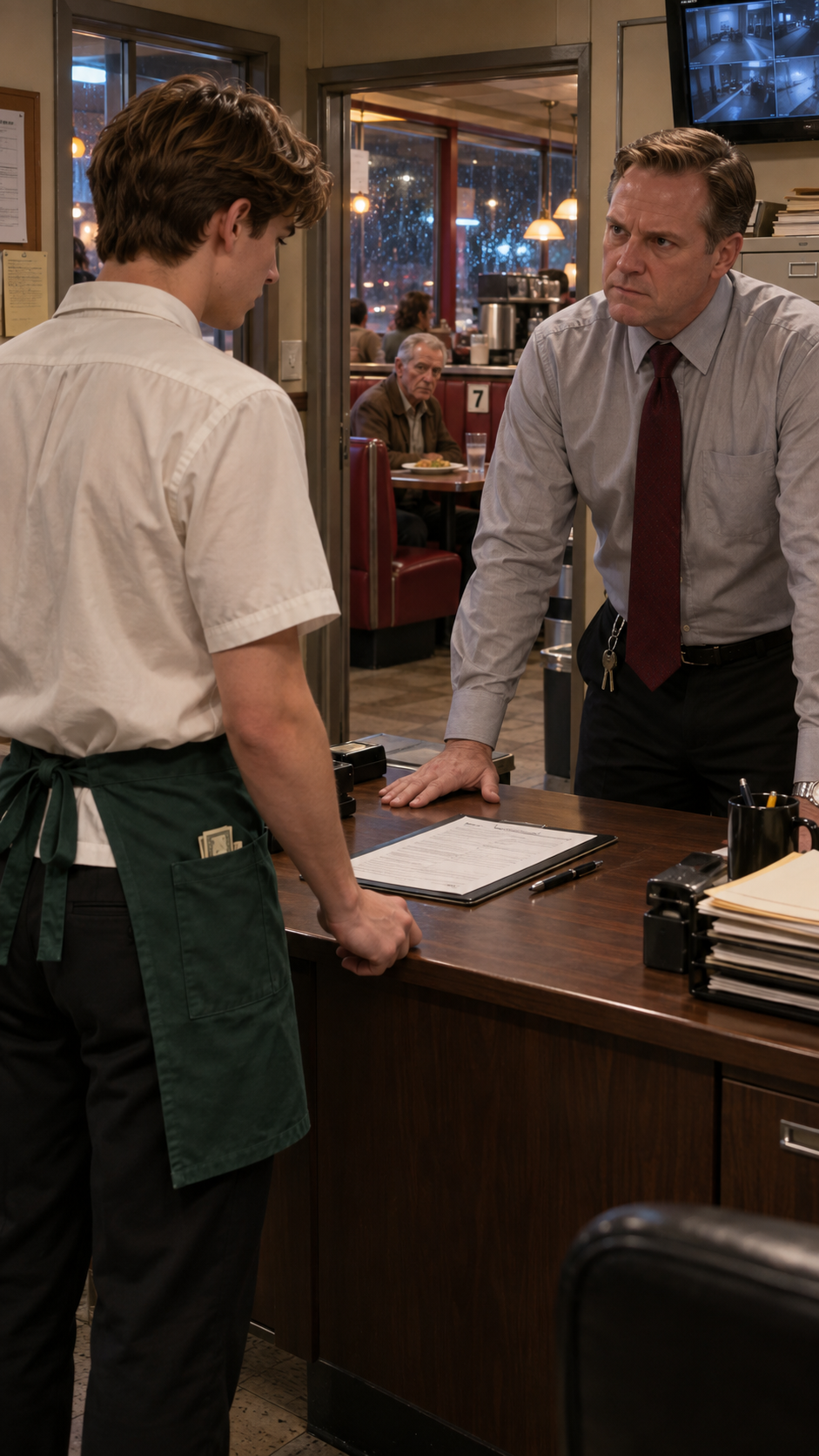
Dale shut the office door hard enough to rattle the framed employee certificates on the wall.
The office was barely large enough for his desk, two chairs, a filing cabinet, and the security monitor mounted above a stack of inventory folders.
Through the glass window beside the door, I could still see part of the dining room.
Booth seven was visible near the far wall.
Frank sat quietly beneath the hanging light.
His plate remained untouched.
Dale dropped the transaction report onto his desk.
“What were you thinking?”
“I paid for his dinner.”
“I know what you did.”
“Then I don’t understand the problem.”
“That is the problem.”
I stared at him.
He planted both hands on the desk.
“This is a business, Jake.”
“I know.”
“No, you clearly don’t.”
“He ordered food and it got paid for.”
“He didn’t order it.”
“I did.”
“You encouraged someone who obviously cannot afford to eat here to occupy one of my booths.”
I glanced through the window.
More than half the booths were empty.
“Dale, we have thirty open seats.”
“That isn’t the point.”
“What is the point?”
He leaned back.
“The point is standards.”
I almost laughed because I genuinely did not understand what that meant.
“What standard did I break?”
“You made an emotional decision.”
“With my own money.”
“While representing this restaurant.”
“I bought a customer dinner.”
“You turned this place into a charity.”
“One meal is not a charity.”
“It becomes one when people hear about it.”
I frowned.
“Who is going to hear about it?”
“That isn’t relevant.”
“It sounds relevant.”
Dale’s eyes narrowed.
“You need to learn that not every person who walks through that door is someone we want hanging around.”
There it was.
The sentence was cleaner than what he really meant.
Maybe he thought that made it acceptable.
I looked through the office window again.
Frank was sitting alone beneath a yellow light, wearing a wet brown jacket and eating a dinner that had cost less than fifteen dollars.
“What exactly is wrong with him?”
Dale exhaled through his nose.
“Don’t do that.”
“Do what?”
“Pretend you don’t understand how business works.”
“I’m asking what’s wrong with him.”
“He came in with no money.”
“He had money.”
“He couldn’t afford a meal.”
“So?”
Dale lowered his voice.
“People like that become problems.”
The words landed harder than I expected.
Not because they were loud.
Because they were familiar.
I had heard versions of them in grocery stores.
At school.
At the pharmacy where my mother worked.
People like that.
Poor people.
Old people.
Homeless people.
People wearing the wrong clothes.
People whose debit cards declined.
People who needed an extra minute.
People who embarrassed comfortable strangers by reminding them how quickly comfort could disappear.
I looked at Dale.
“What kind of people?”
His mouth tightened.
“You know what I mean.”
“I want to hear you say it.”
That was probably the moment I lost my job.
Dale stared at me as though an eighteen-year-old employee had just committed an act of rebellion.
“You’re not here to question my decisions.”
“I’m not questioning your decision.”
“You absolutely are.”
“I’m asking why buying a man dinner is a problem.”
“Because I told you it is.”
There was the real answer.
Authority.
Not policy.
Not money.
Not theft.
Authority.
I should have stopped.
I knew that.
My mother needed my paycheck.
I needed my schedule.
I needed the twelve dollars still sitting in my apron.
I needed this job far more than I needed to win an argument.
But something about Frank sitting in booth seven while we discussed him as if he were a stain on the carpet made silence feel worse.
“The food was paid for.”
Dale tapped his finger against the desk.
“I don’t care.”
“No customer complained.”
“I don’t care.”
“He isn’t causing trouble.”
“I don’t care.”
“Then what are we actually talking about?”
Dale opened a drawer.
“We’re talking about whether you understand who runs this restaurant.”
He pulled out a form.
I knew what it was before he placed it on the desk.
TERMINATION NOTICE was printed across the top.
My stomach dropped.
For a moment, the entire argument vanished.
All I could see was my mother standing at our kitchen counter with the electric bill.
I thought about the gas tank.
I thought about the college envelope.
I thought about groceries.
I thought about how many job applications I would have to fill out before someone called.
Dale saw the fear in my face.
I know he did.
His shoulders relaxed.
That hurt worse than the form.
“You’re firing me?”
“I’m giving you a consequence.”
“For buying food?”
“For refusing to follow management direction.”
“You never told me I couldn’t buy a customer dinner.”
“It should be common sense.”
“It isn’t in any policy.”
“This isn’t a courtroom.”
“I’m not saying it is.”
“Then stop arguing like a lawyer.”
My hands had started shaking.
I put them beneath the desk so he would not see.
“I’ve never missed a shift.”
“That’s irrelevant.”
“I stayed until two last Friday because Marcus called out.”
“Also irrelevant.”
“I came in on Thanksgiving last year.”
“And you were paid.”
“I’ve never had a write-up.”
“You do now.”
He slid the form toward me.
I did not touch it.
“Dale, I need this job.”
He looked at me with something that was almost satisfaction.
“Then you should have thought about that before you made an emotional decision.”
I hated that sentence.
Not just because of what it meant for me.
Because I could tell he had been waiting to use it.
He wanted me to understand that compassion was weakness and that he was the person teaching me adulthood.
“The world doesn’t reward people for making emotional decisions, Jake.”
I stared at the termination form.
At eighteen, adults still have a strange power over you even when you know they are wrong.
Part of you assumes age must have taught them something you have not learned yet.
I wondered if maybe Dale was right.
Maybe kindness was expensive.
Maybe caring was irresponsible.
Maybe people like me simply could not afford principles.
Then I looked through the office window.
Frank was cutting another piece of meatloaf.
That meal had cost me fourteen dollars and eighteen cents.
My job was apparently going to cost me much more.
Still, I could not make myself regret buying it.
Dale placed a pen beside the form.
“Sign.”
“What happens if I don’t?”
“It still goes into the file.”
“Then why sign?”
“To acknowledge you received it.”
I read the reason he had written.
INSUBORDINATION / FAILURE TO FOLLOW MANAGEMENT STANDARDS.
Nothing about stealing.
Nothing about unpaid food.
Nothing about customer complaints.
Nothing about the actual reason.
I picked up the pen.
My signature looked uneven.
Dale took the paper.
“Turn in your apron.”
I untied it.
The twelve dollars and change inside suddenly felt unbearably small.
I removed the cash before placing the apron on his desk.
“Your next check will include tonight’s hours.”
“Okay.”
“You can pick it up Friday.”
“Okay.”
“And Jake?”
I stopped at the door.
“Use this as a lesson.”
I looked at him.
“What lesson?”
His expression hardened.
“Business isn’t personal.”
I opened the door.
“Maybe that’s the problem.”
The dining room became quiet when I stepped outside.
I had served most of those customers enough times to recognize them.
A truck driver named Ray looked at me from the counter.
A retired couple in booth three stopped talking.
One of my coworkers, Melissa, stood beside the beverage station holding a coffee pot.
Her eyes moved from my shirt to the apron still inside Dale’s office.
She understood immediately.
“What happened?” she whispered.
“He fired me.”
Her mouth opened.
“For what?”
I glanced toward booth seven.
Frank was already standing.
He walked toward me.
The brown jacket hung loosely around his shoulders.
“I’m sorry.”
I shook my head.
“You didn’t do anything.”
“I’m the reason you’re leaving.”
“No.”
I looked through the office window.
Dale was sitting behind his desk as if nothing significant had happened.
“He’s the reason.”
Frank’s eyes followed mine.
Then he looked back at me.
“I should have refused the dinner.”
“No.”
“If I had—”
“You were hungry.”
“That doesn’t make this acceptable.”
“It also doesn’t make it your fault.”
For a second, neither of us spoke.
The rain hammered the windows.
Frank reached into his pocket.
I immediately thought he was going to offer me money.
“Don’t.”
He paused.
“I wasn’t—”
“If you’re going to pay me back, don’t.”
A strange expression crossed his face.
“You just lost your job.”
“Yeah.”
“You have twelve dollars left.”
I stared at him.
“How did you know?”
“You counted before paying.”
I had not realized he was watching.
“I’ll figure it out.”
Frank looked toward Dale again.
“Will you?”
“I always do.”
He lowered his hand.
“Your mother raised you well.”
That sentence almost broke me.
I looked away before my face showed too much.
“Take care of yourself, Frank.”
“You too, Jake.”
I walked toward the employee hallway.
My backpack was hanging on the hook near the rear exit.
Then I remembered my phone charger was still plugged into the outlet beside the break table.
I grabbed both.
Melissa followed me halfway down the hall.
“I’m calling you later.”
“You don’t have to.”
“I’m calling.”
I smiled.
“Okay.”
She hugged me quickly.
“I’m sorry.”
I nodded because if I spoke, I was afraid my voice would shake.
Then I pushed through the rear door.
Cold rain hit my face immediately.
I ran around the building toward the employee parking spaces.
My car sat beneath a broken lamp near the edge of the lot.
For the first ten steps, I was angry.
By the twentieth, I was scared.
By the time I reached the car, I felt numb.
I unlocked the driver’s door.
Then I realized my backpack felt too light.
I opened it.
No wallet.
I checked again.
Then I remembered placing it beneath the register earlier when I paid for a customer’s change out of my own pocket.
“Perfect.”
I slammed the car door.
The rain had soaked through my shirt.
I ran back toward Harrison’s.
Through the front windows, I could see Frank standing beside the register.
Dale had finally left the office.
He looked irritated.
Frank held a phone against his ear.
Something about his posture had changed.
He no longer looked tired.
His shoulders were straight.
His expression was calm.
Not nervous calm.
Certain calm.
I opened the door.
The bell above it chimed.
Frank was speaking quietly.
“Location seventeen.”
Dale stood several feet away.
Frank glanced toward me but continued the call.
“Yes.”
He listened.
“No, I’m fine.”
Another pause.
“Bring Elena, Martin, and whoever is handling regional operations tonight.”
Dale’s forehead creased.
Frank turned slightly away.
“My name is Frank Mercer.”
I froze.
The name meant nothing to me.
It clearly meant something to Dale.
The color slowly left his face.
Frank continued.
“I need you to come to Harrison’s location seventeen.”
Then he ended the call.
Nobody spoke.
The only sound in the restaurant was rain.
Dale stared at Frank.
“Did you say Mercer?”
Frank slipped the phone into his jacket.
“Yes.”
Dale’s voice changed completely.
“Frank Mercer?”
Frank looked at him.
“That’s what I said.”
I still had no idea why that mattered.
Dale did.
And watching his face, I understood something impossible had just happened.
The old man he had dismissed as one of “those people” was somebody Dale recognized.
Frank turned toward me.
“You came back.”
“My wallet.”
I pointed toward the register.
Melissa picked it up and handed it to me.
“Thanks.”
I started toward the door again.
“Jake.”
I stopped.
Frank’s voice was quiet.
“Stay for a few minutes.”
I looked at Dale.
Then at Frank.
“Why?”
Frank glanced through the rain-streaked windows.
“Because the people I called need to hear what happened from you, not from me.”
Outside, headlights appeared at the entrance to the parking lot.
One pair.
Then another.
Then another.
Three black SUVs turned toward the restaurant.
And for the first time since Dale handed me that termination form, I realized my night was not over.
Leave a Reply