
CHAPTER 1 – THE MAN IN BOOTH SEVEN — I Was Fired for Buying Him Dinner
PART 1: Because You’re Hungry
I was eighteen years old when my manager fired me for buying dinner for a hungry old man, and at the time I honestly thought losing my job was the worst thing that could happen that night.
I had no idea that the quiet stranger sitting in booth seven was about to make one phone call that would bring several black SUVs into the parking lot.
More importantly, I had no idea that what happened before that call would matter far more than anything that came afterward.
By the end of the night, my manager would discover that his biggest mistake was not failing to recognize an important man—it was believing an unimportant man deserved less respect.
My name is Jake, and back then I worked six nights a week at Harrison’s Roadside Grill outside Columbus, Ohio.
Harrison’s was the kind of place truckers stopped after long highway runs, families visited after Little League games, and tired people wandered into when they wanted hot coffee without having to dress nicely or explain themselves.
The red vinyl booths were cracked along the seams, the floor always smelled faintly of coffee no matter how often we mopped it, and the old fluorescent sign outside buzzed loudly enough to hear from the employee parking spaces.
It was not glamorous, but that restaurant mattered to me because my paycheck mattered.
My mother worked at a pharmacy on the east side of Columbus, but her hours had been cut twice that fall, and every time the schedule changed she came home pretending she was relieved to have more time when both of us knew what fewer hours really meant.
Our electric bill was overdue.
The transmission in her twelve-year-old Chevrolet slipped whenever she accelerated too quickly.
Our kitchen cabinet contained more canned soup than actual groceries.
I had graduated from high school that spring and planned to start community college once I could save enough to cover books, fees, gas, and whatever expenses appeared after people told you tuition was supposedly affordable.
Most weeks, saving meant putting twenty dollars into an envelope and taking fifteen of it back out three days later because life had invented another emergency.
I did not resent helping my mother because she had spent eighteen years helping me.
After my father died when I was fourteen, she had worked morning shifts, evening shifts, holiday shifts, and shifts where she came home rubbing the arches of her feet because standing another hour felt impossible.
The one thing she hated was knowing I was doing the same thing.
“Your money is supposed to get you somewhere, Jake,” she always told me.
I usually answered, “Keeping the lights on is somewhere.”
She never laughed when I said it.
That Tuesday night in November, rain had been falling since before my shift began.
It hammered the metal awning over the entrance, streaked the windows silver, and turned the parking lot into a black mirror reflecting the yellow restaurant lights.
Business had been slow because sensible people stayed home during weather like that.
By eight-thirty, only seven tables were occupied in a dining room that could seat nearly eighty people.
I had a little more than twenty-six dollars in tips folded inside the front pocket of my apron.
The fuel warning light in my car had turned on during the drive to work, so I had already calculated that twelve dollars needed to go into the gas tank before I drove home.
Another ten could buy milk, bread, eggs, and maybe a box of cereal if I stopped at the discount market before it closed.
The remaining four dollars and change were technically mine.
That was how I thought in those days.
Every dollar already had a name.
Gas.
Food.
Electricity.
College.
Emergency.
There was almost never a category called Jake.
My manager, Dale Hargrove, thought that made me foolish.
Dale was thirty-eight, though he carried himself like somebody who had already become tired of the entire human race.
He wore his restaurant tie pulled too tight around his neck, kept his keys clipped to his belt, and had a habit of tapping his pen against the register whenever customers took too long deciding what they wanted.
He was not the kind of manager who screamed constantly.
That would have been easier.
Dale preferred small reminders that he controlled the schedule, the sections, the breaks, and whether you could afford next month.
He noticed when people were afraid of losing hours.
Then he used that knowledge.
I had learned early to keep my head down.
I arrived ten minutes before every shift.
I covered for people who were sick.
I cleaned sections that were not mine.
I smiled when customers complained that their fries were too crispy, not crispy enough, too salty, too cold, or somehow all four.
Dale still found things to criticize.
“You care too much what people think,” he once told me after I spent five minutes helping an elderly woman find the hearing aid she had dropped beneath a booth.
I thought he was joking.
He was not.
That night, at eight forty-seven, the front door opened and a gust of wet November air rolled across the dining room.
An elderly man stepped inside.
I remember looking at him immediately because he seemed almost swallowed by the oversized brown jacket he wore.
Rain darkened the shoulders of the coat.
His gray hair was wet and flattened against his forehead.
Mud clung to the edges of his shoes.
He held a worn leather wallet in one hand as though he had taken it out before coming through the door.
Nobody insulted him.
Nobody laughed.
Nobody told him he did not belong.
Almost everyone simply glanced at him and then looked away.
A couple near the window resumed their conversation.
A delivery driver bent back over his phone.
Two teenagers sharing fries barely noticed him.
Dale looked up from the register long enough to take in the wet jacket, old shoes, and tired posture.
Then he pointed without leaving his stool.
“Booth seven.”
There was something about the way he said it that bothered me.
Not because booth seven was bad.
It was simply the booth farthest from the entrance, tucked beside the hallway leading toward the restrooms and employee area.
It was where Dale seated people when he expected them to order little, stay too long, or require more attention than he thought they were worth.
Booth seven happened to be in my section.
I grabbed a menu, filled a glass with ice water, and walked over.
“Evening, sir, I’m Jake.”
The old man looked up at me.
His face was lined with age, but his eyes were unusually sharp.
“Frank,” he said.
“Good to meet you, Frank.”
I set down the water and handed him the menu.
“Can I get you coffee while you look?”
Frank glanced toward the price printed beside the coffee.
“Water’s fine.”
There was nothing unusual about that answer, but I noticed how long his eyes remained on the price.
I nodded and told him I would give him a minute.
When I returned five minutes later, the menu was still open to the same page.
Frank had not touched the water.
Instead, he seemed to be studying the prices as carefully as somebody reading a legal contract.
“What can I get you?” I asked.
He hesitated.
“How much is the vegetable soup after tax?”
I told him.
He looked down at the menu again.
“And coffee?”
I told him that too.
His thumb moved across the edge of his wallet.
“Is the roll included with the soup?”
“One roll.”
He nodded slowly.
Then he opened the wallet.
I was not trying to look inside.
I simply happened to be standing close enough to see several worn one-dollar bills and what looked like a five.
Frank counted them beneath the table.
Then he closed the wallet quickly.
“Just water,” he said.
I thought I had misunderstood.
“You sure?”
“Yes.”
“You can take another minute if you want.”
“I already decided.”
He gave me a small smile.
“It’s been a long day.”
His stomach growled before he finished speaking.
Frank looked down.
I pretended I had not heard it.
The problem was that I had heard it.
More than that, I recognized the expression that followed.
Embarrassment.
Not dramatic embarrassment.
Not the kind where somebody turns red and makes a scene.
It was quieter than that.
It was the look of someone who had learned to apologize for needing something.
My mother had worn the same expression plenty of times.
After my father died, she occasionally announced she had eaten at work when I knew she had not.
She would cook one grilled cheese sandwich, place it in front of me, and claim she had lost her appetite.
When I was younger, I believed her.
By seventeen, I understood.
“Frank,” I said.
He looked up.
“If money wasn’t part of the decision, what would you actually eat?”
His forehead creased.
“What?”
“Pretend everything on the menu costs the same.”
He stared at me as though the question itself had surprised him.
I leaned slightly toward the table.
“What sounds good?”
Frank glanced down.
For the first time since sitting, he stopped reading the numbers.
His eyes moved instead toward the descriptions.
“The meatloaf sounds good.”
“That’s one of the better things here.”
“With mashed potatoes?”
“And gravy.”
“Green beans?”
“Yep.”
He gave the smallest laugh.
“And the roll?”
“Roll too.”
Frank closed the menu.
“That would be my answer.”
“All right.”
I picked up the menu.
“One meatloaf dinner.”
His smile disappeared.
“I didn’t order it.”
“I know.”
“Jake.”
“I’m buying it.”
Frank sat straighter.
“No.”
“It’s okay.”
“It isn’t.”
“It really is.”
“You don’t need to do that.”
“I know.”
“I can’t pay you back.”
“You don’t have to.”
His expression hardened slightly, and I realized I had embarrassed him in a different way.
“I’m not asking for charity.”
“I’m not offering charity.”
“What would you call it?”
“Dinner.”
Frank studied my face.
Then he glanced at my apron.
“You’re eighteen, maybe nineteen?”
“Eighteen.”
“You’re working in a roadside diner on a Tuesday night.”
“Correct.”
“You don’t look like somebody who has money to waste.”
I laughed before I could stop myself.
“That’s because I don’t.”
“Then keep it.”
My fingers touched the folded bills in my apron.
I thought about the gas light.
I thought about milk.
I thought about the overdue electric bill.
For one second, I almost listened to him.
Then I pictured my mother sliding half her dinner onto my plate years earlier and pretending she was full.
“It’s fourteen dollars and change,” I said.
“That matters to you.”
“Yeah.”
“Then why would you spend it on someone you don’t know?”
I looked at him.
“Because you’re hungry.”
Frank went completely still.
The rain rattled against the window beside us.
Somewhere behind me, plates clattered as the dishwasher loaded another rack.
Frank finally spoke.
“You know nothing about me.”
“That’s true.”
“You don’t know whether I’m a good person.”
“No.”
“You don’t know what I’ve done.”
“No.”
“You don’t know whether I deserve your money.”
I shook my head.
“I didn’t know people had to earn the right to eat dinner.”
Something changed in his face.
His eyes dropped for a moment.
Then he nodded once.
“Only if you sit for a minute when you get a break.”
I smiled.
“Deal.”
I rang in the meatloaf under my employee number and paid for it with my own cash.
The total came to fourteen dollars and eighteen cents.
When the register drawer closed, I had twelve dollars and some change left in my apron.
Dale was in his office.
He never saw the transaction happen.
At the time, I thought that meant the whole thing would remain between Frank and me.
Ten minutes later, I carried a hot plate toward booth seven.
Steam rose from the mashed potatoes.
Brown gravy ran across the meatloaf.
The green beans were not anything special, and the roll came from a plastic bag, but Frank looked at that plate like I had placed a Thanksgiving dinner in front of him.
“For you.”
He stared at it.
Then he looked at me.
“Thank you, Jake.”
“It’s meatloaf, Frank.”
“No.”
His voice became quieter.
“It isn’t.”
I did not understand what he meant.
I smiled awkwardly and started to turn away.
“Wait.”
Frank nodded toward the empty side of the booth.
“You promised me a minute.”
I glanced toward the kitchen.
My other tables were fine.
Dale was still nowhere in sight.
I slid into the booth across from Frank.
He cut a piece of meatloaf.
Before eating it, he asked, “Why six nights a week?”
I blinked.
“How do you know I work six nights?”
“You have the look.”
“What look?”
“The look of someone whose feet hurt before the shift starts.”
I laughed.
“Okay, fair.”
Frank waited.
I shrugged.
“My mom works at a pharmacy, but they cut her hours.”
“So you help.”
“It’s just us.”
“Your father?”
“He died when I was fourteen.”
Frank stopped moving.
“I’m sorry.”
“Thanks.”
“What happened?”
“Heart attack.”
I had repeated those two words so many times they usually felt like facts belonging to someone else.
Frank did not ask anything else about it.
He simply nodded.
“And school?”
“Community college eventually.”
“What do you want to study?”
“I don’t know yet.”
“That’s allowed.”
“People keep asking like I should have a five-year plan.”
“People with five-year plans usually discover the next five years have plans of their own.”
That actually made me smile.
“I’d like business classes, maybe accounting.”
“Why accounting?”
“Numbers make sense.”
Frank raised an eyebrow.
“Do they?”
“More than people.”
That earned a laugh.
For the next two minutes, Frank ate while I told him about the envelope in my bedroom where I kept my college money.
I did not tell him how little was actually in it.
He did not ask.
Then the kitchen bell rang.
I stood.
“Duty calls.”
Frank looked down at the plate.
“Jake?”
“Yeah?”
“You think this was a small thing.”
I shrugged.
“It was dinner.”
He looked directly at me.
“I hope you never let anyone convince you that small kindness is worthless.”
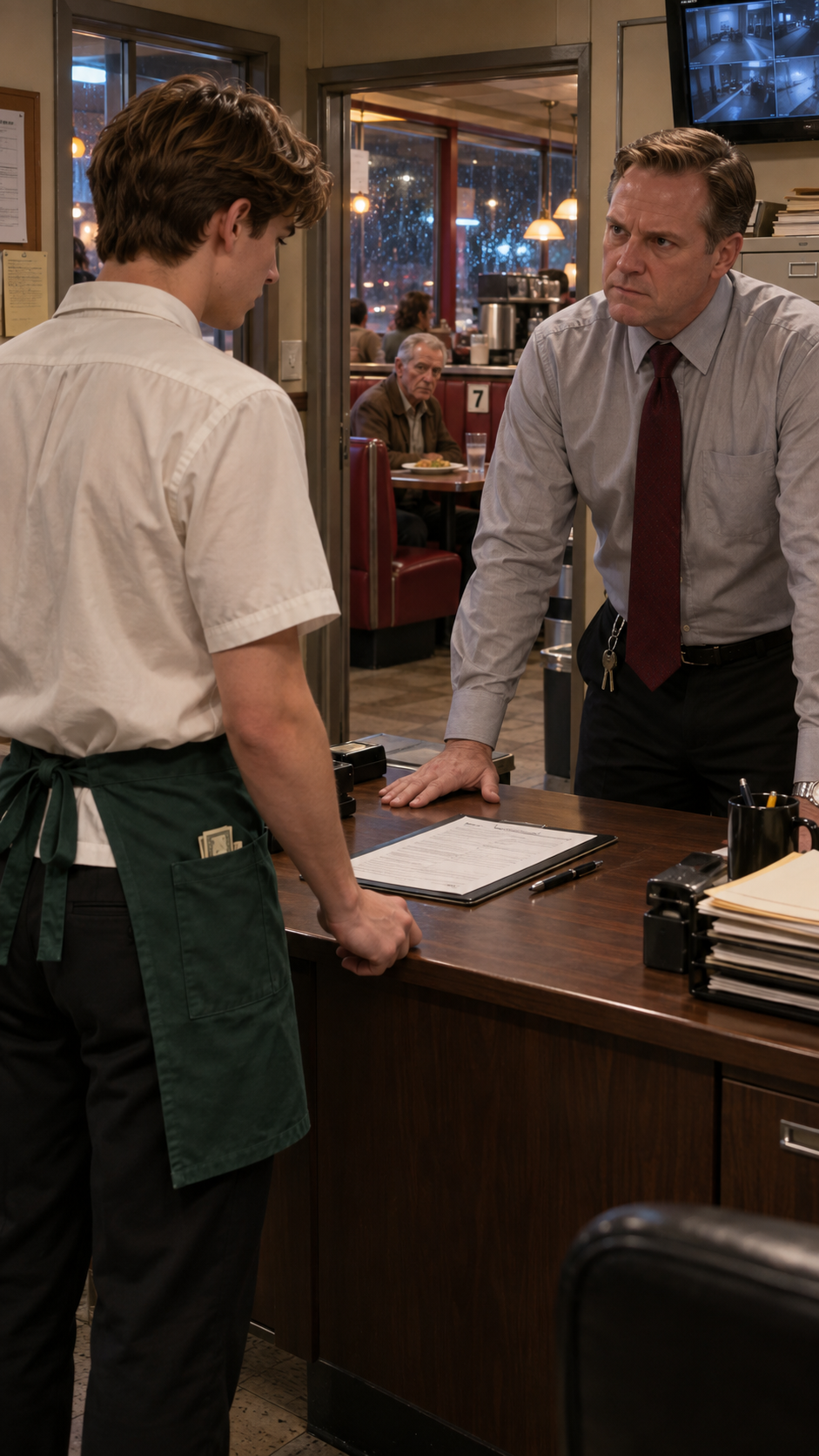
Before I could answer, Dale’s office door opened.
He stepped into the dining room holding a sheet of printer paper.
I recognized the restaurant’s transaction report.
Then I saw my employee number highlighted near the bottom.
Dale looked across the room.
His eyes found me.
Then they moved to the meatloaf in front of Frank.
His face changed.
“Jake.”
Every employee knew that tone.
I walked toward him.
Dale raised the paper.
“Why is there an employee-paid transaction on booth seven?”
I glanced at Frank.
“I paid for his dinner.”
Dale stared at me.
“Why?”
“Because I wanted to.”
“That isn’t an answer.”
“It’s my money.”
His jaw tightened.
“Come with me.”
Frank stood.
“He paid for the meal in full.”
Dale looked toward him.
The polite customer-service smile appeared instantly.
“This is an employee matter, sir.”
“There was no loss to your restaurant.”
“I said this is an employee matter.”
Frank’s expression went still.
Dale turned back to me.
“Office.”
Everyone was watching now.
I followed him.
As I entered the office, I glanced back once.
Frank had sat down again.
But he was no longer eating.
He was watching Dale.
And for the first time that evening, the tiredness had disappeared from his eyes.
Leave a Reply