
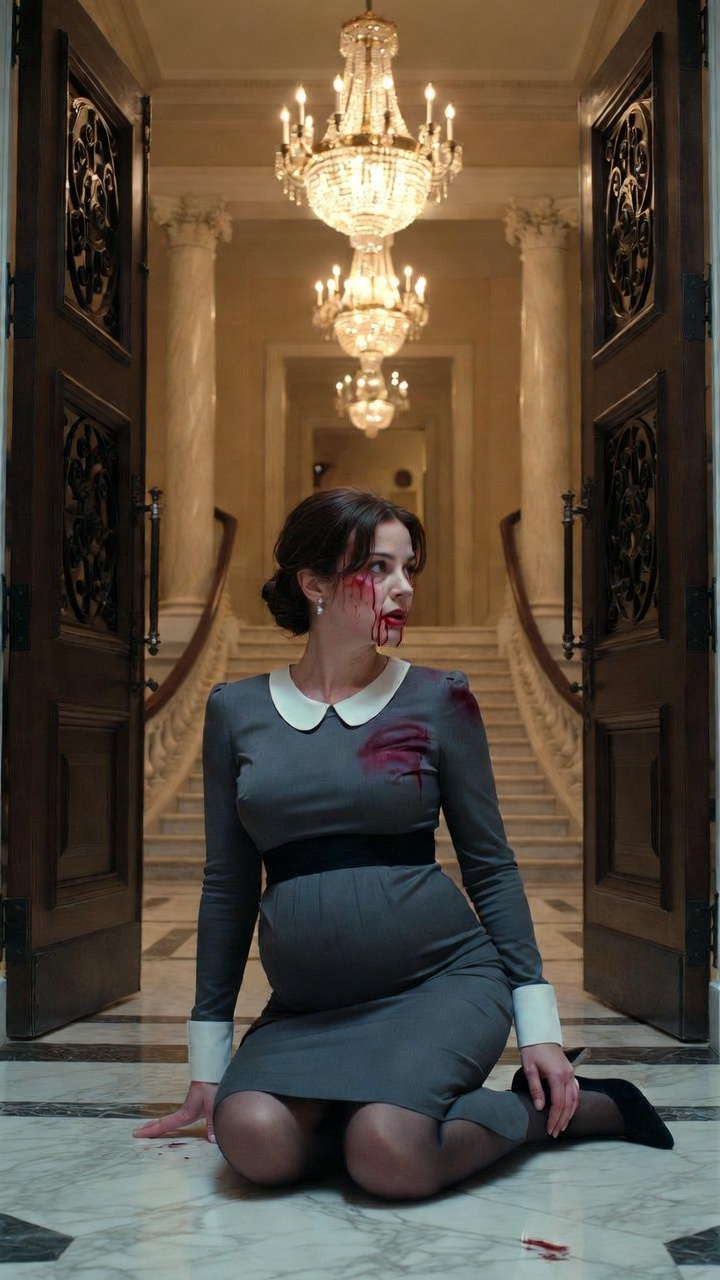
CHAPTER 5 – PART 5 – They Beat the Pregnant Maid and Threw Her Out—Then the Father Walked Through the Door
PART 5: THE HOUSE HE CHOSE TO BUILD
For the first week after I left, Dante did not ask me to come back.
That mattered.
He called every morning.
He came to every medical appointment.
He sent no jewelry.
No car.
No flowers large enough to require their own address.
The first thing he brought me was a bag of groceries because I mentioned over the phone that I was too tired to shop.
The second thing he brought was a folder.
I looked at it suspiciously.
“If this is paperwork transferring something expensive into my name, I’m throwing it out the window.”
“It’s worse.”
“What is it?”
“Employment policy.”
I laughed before I could stop myself.
He sat across from me at the small kitchen table.
The man who had spent most of his adult life in boardrooms looked absurdly large in my apartment.
“What employment policy?”
“Household staff.”
My smile disappeared.
He opened the folder.
“I had outside counsel review every domestic employment practice at the mansion.”
I stared at him.
“Dante.”
“Written contracts.”
“Independent complaint procedures.”
“Medical leave.”
“Maternity protections.”
“No family member can dismiss an employee without written review from the household manager and HR.”
I blinked.
“HR?”
“I moved the household staff under the company’s employee protections instead of leaving everything informal.”
“That’s not nothing.”
“No.”
He pushed another page toward me.
“Rosa helped.”
That made me smile.
“I’m sure she enjoyed telling lawyers how badly the house was run.”
“She used the phrase feudal circus.”
“That sounds like Rosa.”
“There’s more.”
I waited.
“My mother no longer has authority over staff.”
“And Beatrice?”
“None.”
“What happened with them?”
His expression changed.
“I told them they could have relationships with me if they wanted them.”
“But?”
“They will not have access to you or our child without your agreement.”
I looked down.
“And the assault?”
“I asked you what you wanted.”
“You did.”
“You never answered.”
“I didn’t know.”
“Do you know now?”
I thought about Caterina’s cane.
About Beatrice’s hand.
About Thomas standing terrified in the foyer.
About every employee who had learned silence because their wages depended on it.
“I want the incident documented.”
“It is.”
“I want them to understand that I could report it.”
“They do.”
“I’m not ready to decide whether I will.”
“That’s your decision.”
I studied him.
“You’re not going to pressure me either way?”
“No.”
That answer mattered more than if he had promised punishment.
I closed the folder.
“You did all this in a week?”
“I haven’t slept.”
“That part I believe.”
He smiled weakly.
Then he looked at me.
“I was wrong.”
I waited.
“About what?”
“I thought not being cruel made me different from them.”
I said nothing.
“It doesn’t.”
His eyes dropped to his hands.
“I lived in that house and benefited from the same system because I never had to see what it cost anyone else.”
“You treated staff fairly.”
“That’s a low standard.”
“Yes.”
He looked at me.
“I should have noticed.”
I remembered what he had said in the foyer months earlier.
Tell me if anyone treats you badly.
At the time, it had sounded protective.
Now we both understood the problem.
He had expected the vulnerable person to identify the danger to the powerful person.
“I could have told you more,” I said.
He shook his head.
“That doesn’t absolve me.”
“No.”
“But it matters.”
He reached across the table.
I let him take my hand.
“I’m not asking you to forgive my mother.”
“Good.”
“I’m not asking you to return.”
“Good.”
“I’m asking whether I can keep proving I mean what I say.”
My throat tightened.
“Yes.”
That was how we began again.
Not with a dramatic reconciliation.
With proof.
One day at a time.
Dante visited my apartment instead of asking me to enter his world.
He learned how to cook three meals badly and one meal well.
He assembled a crib while swearing at an instruction manual written in twelve languages.
He attended a prenatal class where an eighty-year-old volunteer told him he breathed too loudly.
He laughed more.
I trusted him more slowly.
Rosa visited every Sunday.
She reported changes from the mansion with the seriousness of an intelligence officer.
“Beatrice attempted to enter last Thursday.”
“What happened?”
“Security told her no.”
I nearly choked on my tea.
“How did she take it?”
“She threatened to have them fired.”
“And?”
“They reminded her she no longer has authority.”
Rosa smiled.
“I almost kissed both guards.”
Caterina called me only once.
I nearly ignored the number.
Then I answered.
“Elena.”
Her voice sounded older.
“Donna Caterina.”
A pause.
“You don’t have to call me that.”
“I know.”
Another pause.
“I owe you an apology.”
I said nothing.
What followed was not a perfect apology.
People like Caterina rarely transformed in one conversation.
She began with explanations.
She spoke of fear for Dante.
Family expectations.
People who had tried to use the Moretti name.
Scandals she had spent decades preventing.
I listened.
Then I interrupted.
“None of that explains the cane.”
Silence.
“No.”
“None of it explains Beatrice hitting me.”
“No.”
“None of it explains sending Rosa away or taking my phone.”
“No.”
I heard her breathe.
Then she said something I had not expected.
“I was wrong.”
I closed my eyes.
“You were.”
“I thought I was protecting my family.”
“You were protecting your control over it.”
Her breath caught.
“Yes.”
That single word contained more honesty than everything before it.
She continued.
“I don’t expect forgiveness.”
“Good.”
“I would like the chance someday to know my grandchild.”
My hand moved over my stomach.
“That depends on what happens between now and then.”
“I understand.”
“I don’t think you do yet.”
Another silence.
“Then I will learn.”
I did not forgive her that day.
I did not promise access to the baby.
But I did not hang up.
Sometimes boundaries were not doors.
Sometimes they were gates.
And gates could remain closed until the person outside learned how to knock.
Beatrice took longer.
For three months, she sent nothing.
Then one afternoon, an envelope arrived.
No expensive stationery.
No lawyer.
Just her handwriting.
I opened it alone.
She did not excuse herself.
That surprised me.
She wrote that seeing me in the house had awakened something ugly in her long before she knew about the pregnancy.
Dante had always been the center of the family.
The heir.
The one their mother protected.
The person every major decision revolved around.
Beatrice had grown up resenting anyone who seemed capable of changing his attention or his loyalty.
When she saw him watching me, she had decided I was dangerous before she knew anything about me.
Pregnancy turned jealousy into panic.
She admitted she had wanted me humiliated.
She admitted she had wanted me gone.
She admitted that when she slapped me, she had felt justified for one second.
Then ashamed.
The letter ended with one sentence.
I am sorry I needed your surname before I understood what I had done to you.
I read that sentence three times.
Then I folded the letter.
I did not call her.
But I kept it.
By my seventh month, the mansion had become almost unrecognizable.
Not physically.
The chandeliers were still there.
The floors still shone.
The expensive paintings still hung where decorators had decided expensive paintings belonged.
The difference was quieter.
Staff ate scheduled meals instead of eating whenever the family was finished with them.
People took days off without negotiating favors.
Complaints could go through Rosa and outside HR.
A young kitchen assistant became the first staff member in anyone’s memory to tell a Moretti guest that his behavior was inappropriate and remain employed afterward.
Rosa called me immediately.
“You would have enjoyed his face.”
“I’m sorry I missed it.”
“You didn’t.”
“What?”
“Dante installed cameras.”
I laughed.
Of course he had.
Then Rosa became quiet.
“You should see the house sometime.”
My smile faded.
“I don’t know.”
“No pressure.”
“Rosa.”
“I mean it.”
I looked around my apartment.
The crib occupied half the bedroom.
Baby clothes filled a basket near the sofa.
Dante’s coffee cup sat beside mine in the sink because he had left for work twenty minutes earlier.
Somewhere along the way, my small apartment had stopped being only mine.
That did not frighten me anymore.
“I’ll think about it.”
Two weeks later, I returned to the mansion.
Dante did not know I was coming.
Rosa met me at the service entrance.
I stopped outside it.
For six months, this had been the door I used.
Staff entered here.
Family entered through the front.
Rosa looked at me.
“What?”
“I don’t want to go in this way.”
She understood immediately.
“Then don’t.”
We walked around the house.
The front steps seemed taller than I remembered.
My heart began to pound.
The last time I had crossed that threshold, I had been bleeding.
Rosa waited beside me.
“You can leave.”
“I know.”
I climbed the steps.
Thomas opened the door.
He saw me.
For a second, emotion passed over his face.
“Miss Bellandi.”
“Elena.”
He smiled.
“Elena.”
I entered.
The marble floor was spotless.
Of course it was.
My eyes went automatically to the place where I had fallen.
There was no stain.
No mark.
Nothing visible remained.
I had expected that to hurt.
Instead I felt something different.
The absence of blood did not erase what happened.
But what happened did not own the room either.
“Elena?”
Dante stood at the far end of the foyer.
He had just come out of his office.
Surprise transformed his face.
Then joy.
He started toward me.
Stopped.
And waited.
That small hesitation almost made me cry.
He was asking without words.
May I come closer?
I nodded.
He crossed the foyer.
His hands settled carefully around my waist.
My stomach now stood prominently between us.
The baby kicked.
Dante looked down.
“Was that—”
“Yes.”
He put a hand where mine rested.
The baby kicked again.
His face lit up.
I laughed.
Rosa quietly disappeared.
“You came back.”
“For a visit.”
“I’ll take it.”
I looked around.
“You actually changed things.”
“I told you I would.”
“No.”
I touched his chest.
“You told me you would fix things.”
He remembered.
Then smiled.
“I stand corrected.”
We walked through the house.
People greeted me differently now.
Some knew my surname.
That was unavoidable.
But not everyone did.
A new maid named Julia introduced herself without the slightest recognition when I said Bellandi.
Strangely, she became my favorite person in the mansion that day.
She treated me politely because she was polite.
Nothing more.
Nothing less.
In the library, Dante stopped beside the same table where he had first shown me my employment file.
“There’s something I need to ask.”
I looked suspiciously at him.
“If you produce a ring from your pocket, I will walk out.”
His hand stopped halfway toward his jacket.
I stared.
He stared back.
“Oh, no.”
“Elena—”
“You were actually going to do it?”
“I had a speech.”
“In the house?”
“I panicked.”
“You run a multinational company.”
“This is significantly worse.”
I started laughing.
He looked offended.
Then he laughed too.
I sat on the edge of the desk.
“Dante.”
“Yes?”
“I love you.”
His expression softened.
“But I’m not marrying you because I’m pregnant.”
“I know.”
“And I’m not marrying you because your family expects it.”
“I know.”
“And I’m not moving back into this house just because you changed the employee handbook.”
“I know.”
I looked at him.
“But ask me again after the baby comes.”
He became completely still.
“Is that a yes?”
“It is a request for patience.”
“How much patience?”
“More than you possess.”
He smiled.
“I can work on that.”
Our daughter was born on a rainy April morning.
We named her Sofia after my mother.
Dante cried before I did.
Rosa cried louder than both of us.
Caterina did not come to the hospital.
That was intentional.
She had asked.
I had said no.
She accepted the answer.
Three weeks later, I invited her to my apartment.
She arrived alone.
No driver waiting at the door.
No gifts except a small hand-knitted blanket that was so uneven I immediately knew she had made it herself.
“I haven’t knitted in thirty years,” she said defensively.
“I can tell.”
For one terrible second, I thought I had gone too far.
Then Caterina laughed.
It was the first real laugh I had ever heard from her.
She held Sofia only after asking.
She cried only after trying very hard not to.
I watched her with my daughter and understood that forgiveness, if it came, would not be one grand decision.
It would be hundreds of small ones.
Some days yes.
Some days no.
Some things forgotten.
Other things never forgotten.
Beatrice met Sofia much later.
That meeting was harder.
She stood inside my apartment door looking as though she expected me to change my mind.
Maybe part of her hoped I would.
I placed Sofia in her arms.
Beatrice immediately cried.
“I’m sorry.”
“I know.”
“I don’t deserve this.”
“This isn’t about what you deserve.”
She looked at me.
“It’s about what kind of family she grows up in.”
Beatrice held my daughter more carefully.
“I want to be better.”
“Then be better.”
Simple words.
Difficult work.
A year after the day on the marble floor, Dante brought me back to the mansion one evening after dinner.
He led me into the foyer.
I looked around suspiciously.
“What are we doing?”
“Something I should have done somewhere less traumatic the first time.”
He reached into his jacket.
This time I did not threaten to leave.
He lowered himself to one knee.
I immediately started crying.
“That is very unfair.”
“I haven’t even said anything.”
“You practiced.”
“Obviously.”
“I can tell.”
“Elena.”
I laughed through my tears.
Then he looked up at me, and whatever speech he had prepared disappeared.
Maybe that was better.
“You came into this house asking nobody for anything.”
His voice shook.
“And somehow you gave me more than anyone in it ever had.”
“You showed me what I had refused to see.”
“You gave me a daughter.”
“You gave me a chance to become someone I would actually want her to respect.”
He opened the small box.
“I don’t want to rescue you.”
“I know better now.”
“I don’t want to own your future.”
“I want to earn a place in it.”
My hand covered my mouth.
“Elena Sofia Bellandi, will you marry me?”
I looked down at the marble.
The floor was warm beneath my shoes this time.
I thought about the woman who had knelt there bleeding.
The woman who had whispered for people not to hurt her child because she believed nobody would protect her.
I wanted to reach backward through time and tell her something.
Not that a powerful man would arrive.
Not that the cruel people would regret what they had done.
Not that an old surname would suddenly make everyone understand her worth.
I wanted to tell her that none of those things were what saved her.
She had saved the most important part of herself long before the doors opened.
She had refused to believe their cruelty defined her.
She had refused to trade dignity for comfort.
She had refused to let love erase accountability.
She had refused to let money decide whether she mattered.
And when the moment came to choose what happened next, she had chosen for herself.
I looked at Dante.
“Yes.”
His breath left him.
“But.”
He laughed.
“Of course there’s a but.”
“We are not living with your mother.”
“That was never on the table.”
“And Sofia keeps Bellandi as part of her name.”
“She already does.”
“And I keep mine.”
“I would be disappointed if you didn’t.”
“And Rosa gets the first dance after us.”
He blinked.
“You’ve planned the wedding.”
“I have considered possibilities.”
He stood and kissed me.
Somewhere beyond the foyer, Rosa shouted, “Did she say yes?”
I broke the kiss.
Dante closed his eyes.
“You told Rosa?”
“She threatened me.”
“I believe her.”
“Yes!” I shouted.
A cheer erupted from somewhere behind the dining-room doors.
I stared at Dante.
“How many people know?”
He looked guilty.
“Define people.”
I started laughing.
For once, the sound filled the mansion without fear.
Months later, after the wedding, I stood in the same foyer holding Sofia against my shoulder while guests disappeared into the night.
The chandeliers painted gold across the marble.
Dante stood beside me.
Rosa was arguing with a caterer.
Caterina was asleep upstairs after dancing longer than her doctor recommended.
Beatrice was carrying wedding gifts into the library while complaining that rich people bought unnecessarily heavy crystal.
The house was still beautiful.
Still expensive.
Still imperfect.
But it was no longer a place where silence belonged only to people without power.
When Sofia stirred against me, I kissed the top of her head.
Dante slipped his hand into mine.
I thought about my father’s name.
Bellandi.
For years, I had believed protecting it meant refusing to use it.
I understood differently now.
A name was neither a shield nor a crown.
It was simply something handed to you.
What mattered was what you taught people to understand when they heard it.
I looked down at my daughter.
Someday, Sofia would know exactly what happened in this house before she was born.
I would not tell her so she could hate her grandmother.
I would not tell her so she could worship her father.
And I would never tell her that some powerful surname had rescued her mother.
I would tell her the truth.
Her mother had once been treated as though she mattered less because she wore a servant’s uniform.
Her father had once believed fairness was enough until he learned that silence could protect cruelty.
Her grandmother had once confused control with love and had spent years earning back what that mistake cost.
Her aunt had once done something unforgivable and discovered that remorse was not the same thing as repair.
And an entire house had been forced to change because one bleeding woman on a marble floor finally made everyone reveal who they really were.
Sofia would learn one lesson before all the others.
People do not become worthy when you discover who their father was.
They do not become valuable when you learn who loves them.
They do not become human when you find out they carry an important name.
They were human before you asked.
They were worthy before you noticed.
And anyone who needs a surname before understanding that has already told you everything you need to know about them.
I tightened my fingers around Dante’s.
Then I carried our daughter upstairs.
This time, no one asked whether I belonged beneath that roof.
And for the first time, the answer did not matter.
Because I finally knew I could walk through any door I chose.
And I could walk away from any door that required me to forget who I was.
Leave a Reply