
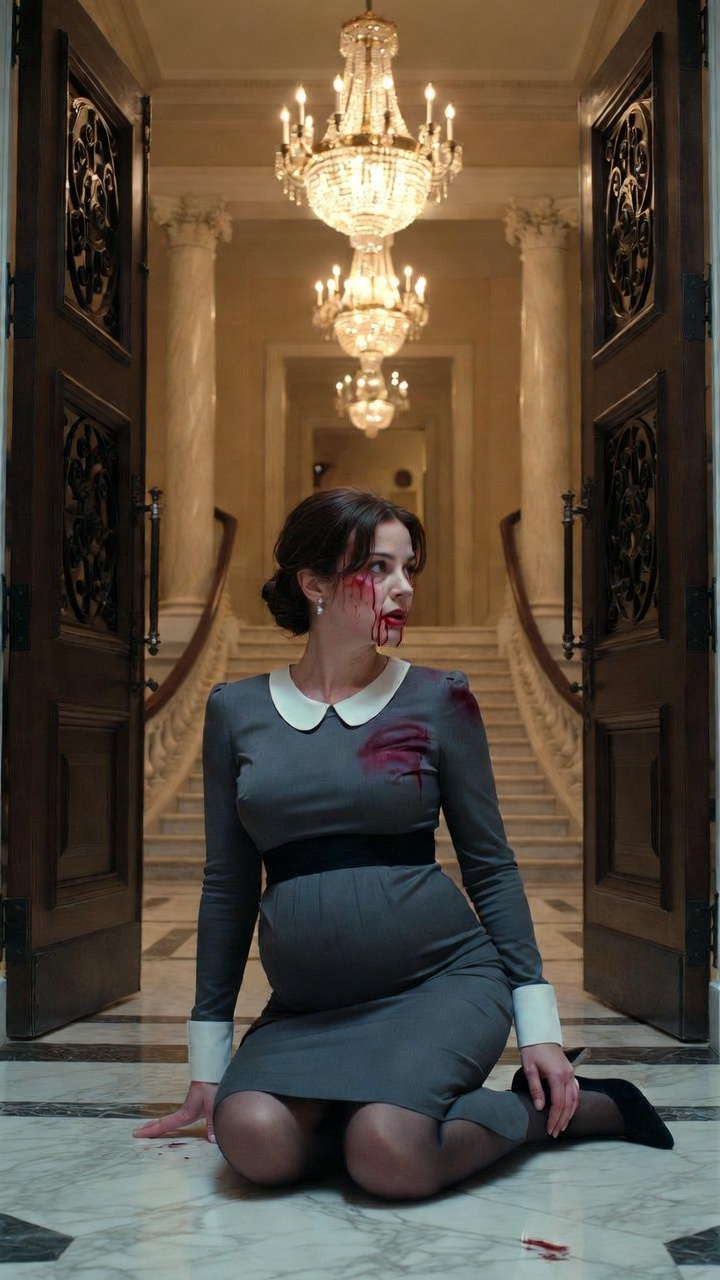
CHAPTER 1 – They Beat the Pregnant Maid and Threw Her Out—Then the Father Walked Through the Door
PART 1: THE NAME NO ONE BOTHERED TO ASK
I felt the marble before I understood why it was cold against my knees.
The foyer of the Moretti mansion stretched around me beneath three crystal chandeliers, every surface polished so perfectly that the blood falling from my split lip looked almost obscene against the white stone.
I could taste iron in my mouth, but my hand did not rise to my face.
It went to my stomach.
Five months was not enough for a stranger to understand what I was protecting at first glance, but it was enough for me to feel the small curve beneath my dress and enough for terror to squeeze the air from my lungs.
Donna Caterina Moretti stood over me with one hand wrapped around the silver head of her walking cane.
She was sixty-two, elegant even when she was cruel, dressed in ivory silk and pearls as though cruelty became respectable when it wore expensive fabric.
She did not look angry.
That was the part I would remember later.
She looked satisfied.
“A servant carrying a child does not deserve to live under this roof,” Beatrice Moretti said from several feet away.
Beatrice was Caterina’s daughter, younger than Dante by six years and old enough to understand exactly what was happening.
One of her heels touched my suitcase and shoved it across the marble toward the front doors.
“Throw her out,” she said.
Then she looked at my stomach.
“If she loses the baby, that’s her problem.”
Something inside me broke at those words, but it was not the part of me that mattered.
I curled over my stomach and whispered, “Please don’t hurt my baby.”
The front doors opened before Caterina could answer.
The sound rolled through the foyer like thunder.
Cold November air rushed inside.
A man stepped through the doorway carrying the black overcoat he had removed during the drive from the airport.
He was not supposed to be home until after midnight.
It was barely six in the evening.
For one strange second, nobody moved.
Dante Moretti’s eyes found me on the floor.
Then they found the blood.
Then the cane.
His hands closed into fists.
“Who touched her?”
No one answered.
Six months earlier, most of the Moretti family could not have told anyone my last name.
That had been intentional.
I arrived at the mansion on a gray morning in May with two bags, a pair of sensible shoes, a sealed reference letter from an elderly family friend, and a promise to myself that nobody in that house would ever learn enough about me to use my past against me.
Rosa Alvarez opened the service entrance and looked me over with the suspicion of a woman who had spent thirty years watching people lie during job interviews.
“You’re early,” she said.
“I thought being late would be worse.”
Her mouth almost smiled.
Almost.
Rosa had buried two husbands, raised three daughters, survived four staff purges, and served three generations of Morettis without ever learning to pretend that wealth impressed her.
She read my reference letter twice.
Then she looked at me again.
“You’ve worked in houses like this before?”
“I grew up around them.”
“That’s not what I asked.”
“No.”
Her eyebrows lifted.
I knew I had already answered too quickly.
She folded the letter.
“Can you iron linen?”
“Yes.”
“Silver?”
“Yes.”
“Formal table service?”
“Yes.”
“Wine placement?”
“Yes.”
“Guest rooms?”
“Yes.”
“Flowers?”
“If they aren’t orchids.”
“Why not orchids?”
“They punish overconfidence.”
That time Rosa actually smiled.
“You’ll do.”
By lunch, I had a uniform.
By dinner, I understood the house.
The Moretti mansion was not a home in the ordinary sense.
It was a machine built to make powerful people feel that the world arranged itself before they entered a room.
Fresh flowers appeared without anyone seeing them replaced.
Cars waited before anyone asked for one.
Meals emerged at exact temperatures.
Bedrooms repaired themselves after guests destroyed them.
Clothes vanished dirty and returned immaculate.
Every inconvenience was removed before the people upstairs had time to notice it existed.
The trick was making that labor invisible.
I was very good at invisible.
I learned quickly that Donna Caterina controlled the domestic side of the house even though her eldest son technically owned the property.
I learned that Beatrice treated staff members according to how recently they had disappointed her.
I learned that Mr. Moretti’s younger cousin, Paolo, drank too much and apologized to furniture after bumping into it.
I learned that Rosa ran the mansion more effectively than anyone with the surname Moretti ever had.
And I learned that Dante Moretti was almost never home.
He ran Moretti International, the hotel and property company his grandfather had built from one lakeside hotel into a business with offices across the country.
Most weeks, he slept in New York, Chicago, Los Angeles, or whatever city required him to fix a problem other executives had failed to solve.
The staff spoke about him differently from the rest of the family.
Nobody called him kind.
Nobody called him cruel either.
They called him fair.
In that house, fairness was unusual enough to become a compliment.
I saw him for the first time on my fourth night.
I was carrying freshly pressed shirts toward the east wing when he came around the corner with his phone pressed to his ear.
He almost walked into me.
I stepped aside.
He stopped.
For a moment, we simply stared at each other.
He was thirty-six, dark-haired, broad-shouldered, and tired in the unmistakable way of a man whose expensive suit could not disguise the fact that he had not slept enough in years.
He ended his call.
“You’re new.”
“Yes, sir.”
He frowned.
“Don’t call me sir.”
I had heard rich men say that before.
Usually they meant, Call me by my first name so I can pretend the distance between us is smaller than it is.
I lowered my eyes.
“Of course, Mr. Moretti.”
One corner of his mouth moved.
“That wasn’t exactly what I meant.”
“I know.”
That made him pause.
I walked past him.
The next morning, Rosa found me rearranging the breakfast service because someone had placed the coffee where Caterina’s left elbow would strike it.
“You made Mr. Moretti laugh.”
I nearly dropped a spoon.
“I did not.”
“He came into the kitchen smiling.”
“Perhaps something happened on his phone.”
“He hasn’t smiled at his phone since 2019.”
I refused to answer.
Rosa watched me too carefully.
That became a problem.
Not because she was unkind.
Because she noticed everything.
Within two weeks, she noticed that Dante began eating breakfast at home on days he normally left before dawn.
She noticed that I was suddenly assigned more often to the east wing.
She noticed that he asked me whether the library windows had always faced west, even though he had lived in that house most of his life.
She noticed that I could identify a nineteenth-century Venetian glass pattern when Beatrice called it “old junk.”
And she noticed that I never seemed intimidated by the expensive things around me.
One evening, while I folded napkins in the service pantry, she leaned against the counter.
“Elena.”
“Yes?”
“Who are you?”
I looked at her.
“I’m the woman folding your napkins incorrectly, apparently.”
“You’re folding them perfectly.”
“Then I don’t understand the interrogation.”
“You know which fork belongs to which course without checking.”
“So do you.”
“I’ve done this for thirty-two years.”
“I pay attention.”
“You corrected the florist in French yesterday.”
“She asked me a question.”
“You understood her.”
“Yes.”
“You also knew how to address the Italian consul’s wife.”
“That was difficult to miss after Beatrice announced her title three times.”
Rosa’s eyes narrowed.
I smiled.
She sighed.
“You are exhausting.”
“So I’ve been told.”
She let it go.
Dante did not.
Three weeks after I arrived, he came into the library while I was replacing books his mother had ordered removed because their spines did not match the new decorating scheme.
He held a folder.
My stomach tightened immediately.
He placed it on the table between us.
I recognized the edge of my employment paperwork.
“You approved my contract yourself?”
“I approve all permanent household employees.”
“I didn’t realize.”
“Neither did I.”
There was something strange in his voice.
I set down the book in my hands.
“What happened?”
He opened the folder.
His finger rested beside the name written on my tax forms.
Elena Sofia Bellandi.
For the first time since I had entered that house, somebody upstairs knew.
Dante stared at me.
“Bellandi?”
I said nothing.
His expression changed.
Not shock exactly.
Recognition.
“My grandfather had a photograph of your father in his office.”
I swallowed.
“Lots of people had photographs of my father.”
“Alessandro Bellandi personally guaranteed the loan that kept my grandfather’s first hotel from being taken by the bank.”
“That was a very long time ago.”
“My grandfather called him his brother.”
“They were friends.”
“Your family and mine spent Christmas together.”
“Until they didn’t.”
He closed the folder.
“Elena, why are you working in my house?”
I hated the question because I had spent years learning how to answer it without sounding broken.
“My father died.”
“I know.”
“My mother followed two years later.”
“I know that too.”
“The foundation kept their name, the lawyers kept the estate, the creditors kept whatever the lawyers didn’t, and everyone who used to call my parents dear friends discovered they were suddenly very busy.”
His jaw tightened.
I continued before pity could enter his face.
“I still had an education, two healthy hands, and no desire to spend the rest of my life introducing myself as Alessandro Bellandi’s unfortunate daughter.”
“You could have contacted us.”
“For what?”
“For help.”
“That is exactly why I didn’t.”
His eyes stayed on mine.
“I don’t want to be helped because of my father’s name.”
“You’d rather clean my mother’s rooms?”
“I would rather be paid for work I actually do.”
He was silent.
I expected an argument.
Instead he asked, “Does Rosa know?”
“No.”
“Does anyone?”
“The friend who gave me the reference.”
“Why use your real surname on the payroll?”
“Because hiding from society is one thing and committing tax fraud is another.”
He laughed once before he could stop himself.
Then his face became serious again.
“Do you want me to keep this private?”
“Yes.”
“Even from my mother?”
“Especially from your mother.”
Something passed through his eyes at that.
Understanding, maybe.
Or warning.
He slid the folder toward himself.
“All right.”
I should have thanked him.
Instead I said, “You’re not going to fire me?”
“Would you prefer that?”
“No.”
“Then I won’t.”
I picked up the book again.
He walked to the door.
Then he stopped.
“Elena.”
I looked at him.
“If anyone in this house treats you badly—”
“They already treat people badly.”
His expression hardened.
“That isn’t what I meant.”
“I know what you meant.”
“Tell me anyway.”
There was something dangerous in promises made by powerful men because they often sounded like protection until the day you learned they were another form of ownership.
“I can handle myself.”
He looked at me for a long moment.
Then he nodded.
“At least let me know if that changes.”
After he left, I stood alone in the library listening to my own heart.
I told myself it was because my secret had been discovered.
I told myself it had nothing to do with the way he had looked at me.
I was lying.
And that lie would become the first thread in everything that followed.
Leave a Reply