
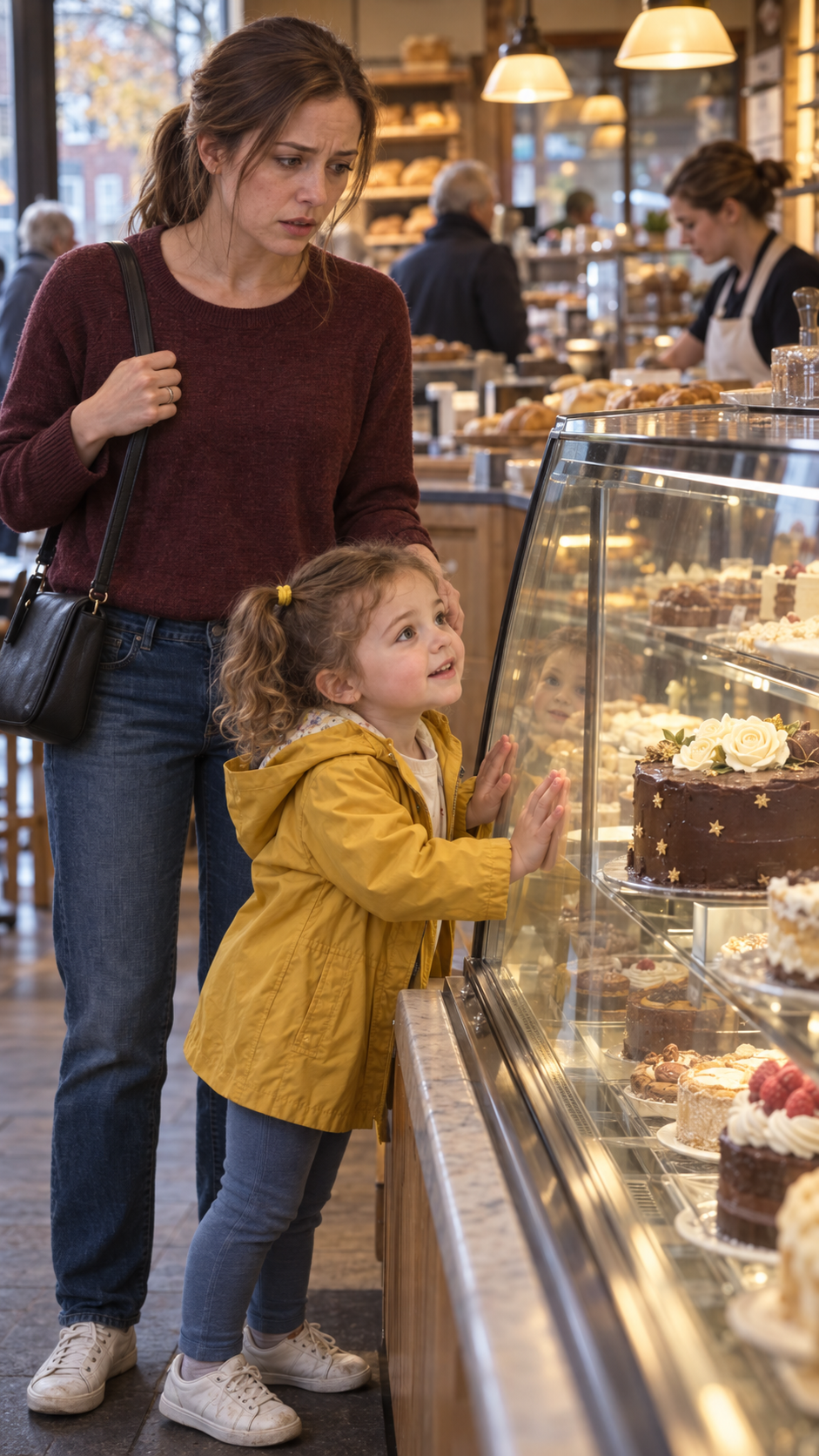
CHAPTER 3 – PART 3 – I Want This Cake—Today Is My Grandpa’s Birthday
PART 3: The Money in Her Pocket
The following morning, Lily woke up asking whether Grandpa was still having his birthday.
“No, birthdays are usually one day.”
She frowned.
“Why?”
“I don’t make the rules.”
“We do Grandpa birthday again.”
“You want another cake?”
“Yes.”
“Of course you do.”
She climbed onto my bed.
“Grandpa happy.”
“Yes.”
“He cry happy.”
I smiled.
“He did.”
She became quiet.
Then she asked something I did not expect.
“Grandpa lonely?”
I stared at her.
Children hear more than adults realize.
“What makes you ask that?”
“You say lonely.”
I silently cursed myself for not speaking more quietly in the kitchen.
“Sometimes Grandpa spends a lot of time by himself.”
“Why?”
“Because he lives by himself.”
“Why?”
I hesitated.
“Because Grandma isn’t here anymore.”
Lily knew my mother only from photographs.
She pointed to the framed picture on my dresser.
“Grandma Susan?”
“Yes.”
“Grandpa miss her?”
“Yes.”
She looked thoughtful.
Then she said, “We go Grandpa house.”
“Not this morning, sweetheart, Mommy has work.”
“After work.”
“We’ll see.”
She folded her arms.
That was never a good sign.
“After work.”
I laughed.
“You’re very bossy for someone who can’t tie her own shoes.”
“I can.”
She could not.
At work that morning, I kept thinking about Dad.
The dental office was busy enough to keep my hands moving but not busy enough to stop my mind.
I answered phones.
I checked insurance forms.
I rescheduled appointments.
But every few minutes, I pictured my father sitting alone after leaving our apartment.
He had gone home carrying the leftover cake and Lily’s drawing.
Had he placed the drawing on his refrigerator?
Had he eaten another slice after midnight?
Had he sat at his kitchen table in silence?
I wondered when loneliness had entered his life.
Maybe it had always been there after Mom died.
Maybe I had simply stopped noticing because grief becomes quieter with time.
People call that healing.
Sometimes it is only adaptation.
My phone buzzed during lunch.
Dad had sent me a photo.
It showed Lily’s drawing attached to his refrigerator with two magnets.
Under it, he had written on a sticky note:
BEST BIRTHDAY CARD EVER.
I smiled.
Then another photo arrived.
This one showed the leftover cake.
Half of it was gone.
I texted:
You ate that for breakfast, didn’t you?
He replied:
No evidence.
I wrote:
There is literally photographic evidence.
He answered:
Circumstantial.
For a few minutes, I forgot about bills and work.
Then I looked again at the picture of the drawing.
Something caught my attention.
Beside the refrigerator was a small calendar.
Yesterday’s date had been circled.
Dad had written only one word inside the square.
Nothing else.
No dinner reservation.
No visitor.
No plan.
Just the number.
I stared at it longer than I should have.
Maybe I was being dramatic.
Maybe he truly had been perfectly content.
But I knew my father.
He would never ask anyone to celebrate him.
He would never say he hoped someone remembered.
He would simply make the day ordinary before anyone else had the chance to disappoint him.
That realization stayed with me until I picked Lily up from preschool.
Her teacher, Ms. Rachel, smiled when we entered the hallway.
“Lily told everybody about the birthday cake.”
I groaned.
“Did she mention that it collapsed?”
“Repeatedly.”
Lily ran toward me holding a sheet of paper.
“We made Grandpa!”
It was another drawing.
This time, several children had apparently participated.
The page was covered with colorful handprints around the words HAPPY BIRTHDAY GRANDPA FRANK.
I looked at Ms. Rachel.
“She insisted.”
“I hope she didn’t interrupt class.”
Ms. Rachel laughed.
“She organized the class.”
“That sounds like her.”
Lily grabbed my hand.
“Take Grandpa.”
“You want to give this to Grandpa too?”
“Yes.”
I almost said not tonight.
I was tired.
The gas tank was low.
Dad lived twenty-five minutes away.
There were dishes in the sink.
Laundry waited.
I had work again the next morning.
Then I remembered his calendar.
“Okay.”
Lily cheered.
We stopped for gas.
I put in ten dollars.
Then we drove to Dad’s small house on the edge of town.
He had lived there for thirty-one years.
It was the house where I grew up.
The paint on the porch railing was peeling.
The maple tree in the yard had gotten enormous.
Mom’s ceramic bird still hung beside the front door even though one wing had cracked years ago.
Lily sprinted up the walkway.
I knocked.
No answer.
“Grandpa!”
Still nothing.
His truck was parked outside.
I tried the door.
Unlocked.
“Dad?”
The house was quiet.
For one horrible second, fear punched through me.
Then I heard a noise from the basement.
“Dad?”
“Down here.”
Relief nearly made my knees weak.
I followed Lily downstairs.
Dad was kneeling beside his workbench.
Parts of an old wooden rocking horse covered the floor.
“What are you doing?”
He looked guilty.
“Nothing.”
I stared at the wooden pieces.
“That doesn’t look like nothing.”
Lily gasped.
“HORSE!”
Dad sighed.
“Well, surprise ruined.”
“What is this?”
He picked up one of the curved wooden runners.
“Found it in the garage last week.”
I recognized it.
The rocking horse had been mine.
Dad built it when I was four.
My mother had painted small blue flowers along the sides.
I thought it had disappeared years ago.
“You kept that?”
“Apparently.”
“You’re fixing it?”
Dad nodded toward Lily.
“For Christmas.”
My throat tightened again.
“Dad, Christmas is three months away.”
“Takes time if you do it right.”
Lily crouched beside him.
“For me?”
He hesitated.
“Well, I suppose there aren’t many other three-year-olds around here.”
She hugged him.
He laughed.
I looked around his basement.
His old tools hung neatly from the wall.
There were jars filled with screws.
Shelves held decades of things he believed might become useful again.
And suddenly I realized my father was already preparing a Christmas gift for Lily while I had almost forgotten his birthday.
The imbalance hurt.
Dad noticed my expression.
“Don’t start.”
“Start what?”
“That face.”
“What face?”
“The guilt face.”
“I do not have a guilt face.”
“You’ve had it since you were twelve.”
I crossed my arms.
“You saved my rocking horse for thirty years.”
“Wood doesn’t expire.”
“Dad.”
He shrugged.
“It deserves another kid.”
Lily was already pretending to ride one of the detached pieces.
I sat on the bottom stair.
“Why didn’t you tell me?”
“Because it’s a surprise.”
“No, I mean about yesterday.”
He looked at me.
“If you wanted company.”
He turned back to the workbench.
“Emma.”
“You could have called.”
“And said what?”
“Anything.”
He tightened a clamp.
“People shouldn’t have to ask people to care.”
The sentence stopped me.
Dad seemed to realize what he had said.
He exhaled.
“That’s not what I meant.”
“Yes, it is.”
He looked embarrassed.
“I wasn’t trying to make you feel bad.”
“I know.”
“I know you love me.”
“I do.”
“And I know you’re busy.”
“I am.”
“Then that’s enough.”
“No.”
He looked at me.
“It should be more than something you know.”
Dad said nothing.
I continued.
“Lily knew yesterday was your birthday because you made birthdays important to her.”
He glanced at Lily.
“She remembered because you remembered her.”
“That kid remembers everything.”
“She remembers how people make her feel.”
Dad smiled faintly.
I stood.
“So do I.”
For the first time, he seemed unsure what to say.
Then Lily suddenly remembered the paper she was carrying.
“Grandpa!”
She unfolded it.
The whole class’s handprints opened across the page.
Dad stared.
“What’s this?”
“My friends say happy birthday.”
“All of them?”
“Yes.”
He counted the handprints.
“Looks like I’ve got a lot of friends.”
“Yes.”
He looked at me.
I smiled.
Dad cleared his throat.
“Need another refrigerator.”
We went upstairs.
Lily helped him tape the giant page to the kitchen wall.
Then she noticed something.
Her coins were sitting in a little ceramic bowl on the counter.
She pointed.
“My money.”
Dad nodded.
“I was going to give it back.”
She shook her head.
“No.”
“It’s yours.”
“For Grandpa.”
“I can’t take your money.”
“Yes.”
“Lily—”
She picked up the quarters and pushed them toward him.
“Buy Grandpa something.”
Dad crouched.
“I already have something.”
“What?”
He tapped her nose.
“You.”
Lily giggled.
“No, buy present.”
“What should I buy?”
She thought deeply.
“Cookies.”
Dad nodded.
“Good investment.”
I laughed.
But then Lily took one of her dollar bills and carefully folded it into his hand.
Dad looked at the crumpled bill.
“You sure?”
She nodded.
“Birthday money.”
He closed his fingers around it.
“Okay.”
Later, I would learn that he never spent that dollar.
He put it inside his wallet behind my mother’s old photograph.
He carried it there every day.
At the time, I only saw him tuck it into his shirt pocket.
“Thank you.”
Lily smiled.
Then she climbed onto a kitchen chair.
“Grandpa hungry?”
“Always.”
“Mommy make food.”
I looked at her.
“Excuse me?”
She pointed toward the stove.
“You assistant.”
Dad laughed so hard he had to hold the counter.
We stayed for dinner.
Dad made grilled cheese.
I heated tomato soup.
Lily dipped everything she could reach into her bowl.
The meal cost almost nothing.
It became one of the best evenings I could remember.
Before we left, Dad walked us to the car.
Lily hugged him.
“Sunday dinner.”
He looked at me.
“Sunday dinner?”
“I told you.”
“You were serious?”
“Yes.”
Dad nodded.
“Then I’ll be there.”
As I buckled Lily into her car seat, Dad leaned toward me.
“You don’t need to fix my life, kiddo.”
“I know.”
“I’m okay.”
“I know.”
He looked relieved.
Then I added, “But okay people still deserve company.”
He smiled.
“Fair enough.”
I drove away.
In the rearview mirror, I watched him remain on the porch until our car turned the corner.
From the back seat, Lily yawned.
“Mommy?”
“Yes?”
“Grandpa happy again.”
I looked at her reflection.
“Yes.”
She closed her eyes.
“Good.”
Within two minutes, she was asleep.
And as I drove home through the dark streets, I realized my daughter had done something in two days that I had failed to do in months.
She had slowed me down long enough to notice someone I loved.
Leave a Reply