
CHAPTER 1 – I Want This Cake—Today Is My Grandpa’s Birthday
PART 1: The Cake Behind the Glass
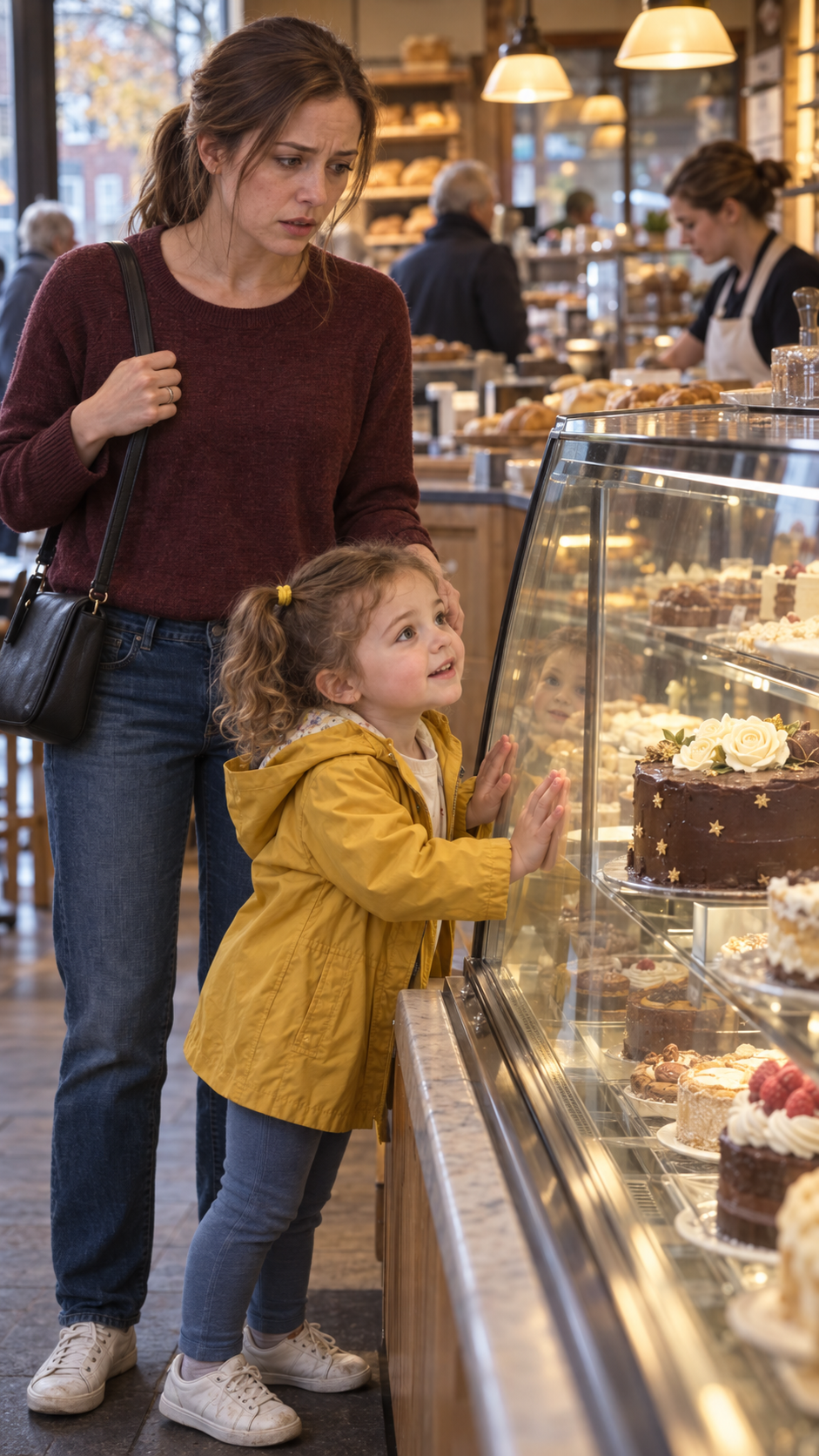
The moment my three-year-old daughter pressed both hands against the bakery case and whispered, “Mommy, I want this cake, today is my Grandpa’s birthday,” I felt my heart sink because I had only seventeen dollars left until payday.
Her name was Lily, and at three years old she still believed that birthdays were sacred promises the world was required to keep.
She believed every birthday needed balloons, candles, a song sung too loudly, and a cake big enough for everyone to have a second slice.
Most of all, she believed nobody should ever have to remind people that it was their birthday.
I wish I could say I had remembered my father’s birthday the moment I woke up that morning, but the truth still makes me ashamed.
I had forgotten.
Not completely, not in the way you forget a stranger’s birthday or a dentist appointment you never wanted to attend, but in the exhausted way important things sometimes get buried beneath survival.
My alarm had gone off at 5:40 that morning, Lily had spilled orange juice on her only clean preschool shirt, the battery warning light had appeared in my old Honda again, and my manager had texted asking whether I could cover an extra afternoon shift.
By eight o’clock, I had already calculated the electric bill twice, postponed buying laundry detergent, and decided that pasta with butter would count as dinner for another night.
My father’s birthday had been somewhere inside my head, hidden beneath all of it.
Lily was the one who remembered.
She had remembered because my father never forgot hers.
Every year, no matter how tired he was, no matter how far he had to drive, and no matter how much his knees hurt, Grandpa Frank appeared at our apartment door carrying a tiny cake and wearing the same crooked paper birthday hat.
He had done it when Lily turned one.
He had done it when she turned two.
And three months earlier, when she turned three, he had arrived twenty minutes before sunrise because I had to work an early shift and he refused to let her leave for daycare without hearing “Happy Birthday” first.
He had brought a strawberry cupcake with pink frosting and three candles.
Lily had talked about that cupcake for weeks.
Apparently, she had also remembered something I had allowed myself to forget.
“Mommy,” she said again, pointing through the glass.
The cake she wanted was a beautiful little chocolate cake decorated with white buttercream roses and tiny gold sugar stars.
A plastic card beside it read $36.99.
I looked down at Lily.
She had her favorite yellow raincoat on even though there was no rain in the forecast, because three-year-olds do not negotiate with weather reports.
Her light brown curls escaped from two uneven ponytails I had made in the parking lot.
She had one sneaker untied.
She was staring at that cake as if she had found buried treasure.
“Sweetheart,” I said gently, “that cake is a little expensive.”
She looked up at me.
“What expensive?”
“It means Mommy doesn’t have enough money for that one today.”
Lily considered this with the seriousness of someone receiving complicated financial news.
Then she reached into the pocket of her raincoat.
She pulled out two crumpled one-dollar bills and three quarters.
I stared at the money in her tiny palm.
“Where did you get that?”
“My money.”
“What money?”
“My Grandpa money.”
I crouched beside her.
“Lily, what is Grandpa money?”
She pointed proudly at herself.
“I saved it.”
Then I remembered.
For months, my father had been giving Lily quarters whenever he visited.
Sometimes he would slip one into her palm and say, “For your college fund.”
Lily had absolutely no understanding of college.
She did, however, understand that coins were shiny and important.
I had bought her a little glass jar shaped like a bear, and she kept her coins inside it along with random treasures that included two buttons, a purple bead, a plastic dinosaur, and a rock she insisted looked like a potato.
Apparently, sometime that morning, she had emptied part of her savings into her coat pocket.
“For Grandpa cake,” she explained.
Something tightened behind my ribs.
I looked at the bakery case again.
Thirty-six dollars and ninety-nine cents might not sound like much to some people.
That morning, it might as well have been three hundred.
I had seventeen dollars in my checking account.
My gas tank was just above empty.
My paycheck would not arrive until Friday.
There were eggs at home, half a carton of milk, flour, sugar, and probably enough peanut butter to survive an apocalypse.
I had become very good at making seventeen dollars behave like fifty.
I had also become tired of telling my daughter that we could not afford things.
“We can’t get that cake, baby,” I said quietly.
Her smile disappeared.
Not dramatically.
Lily was not a child who screamed when she heard no.
She simply turned back toward the glass.
“But Grandpa needs cake.”
The word needs nearly broke me.
“He doesn’t need a cake.”
“Yes.”
She nodded firmly.
“Grandpa birthday.”
“I know.”
“He got me cake.”
“I know.”
“So we get Grandpa cake.”
Children have a brutal way of simplifying the things adults complicate.
In Lily’s world, love had a clear accounting system.
Grandpa remembered her.
Therefore, we remembered Grandpa.
Grandpa brought cake.
Therefore, Grandpa deserved cake.
There were no utility bills or overdraft fees in that equation.
There was no pride.
There was no embarrassment.
There was only love returning to the place it came from.
I stood there staring at the cake while customers moved around us.
A woman collected a box of pastries.
A man ordered coffee.
Someone behind the counter called another customer’s name.
Life continued while I tried not to cry in front of the refrigerated display.
I had spent the past two years convincing everyone, including myself, that I could manage.
Lily’s father had left before her second birthday, and after that there had been child support payments that arrived late, then occasionally, then hardly at all.
I worked the front desk at a dental clinic during the week and picked up weekend shifts at a grocery store whenever my mother could watch Lily.
My mother had died when I was twenty-six, so by “my mother,” I really meant the woman who had been my mother’s closest friend and had become family by refusing to leave us alone.
My father had never been wealthy either.
Frank Miller had spent thirty-eight years repairing heating and air-conditioning systems throughout western Pennsylvania.
He could fix almost anything with wires, screws, or a motor.
He could also somehow make five dollars last longer than anyone I had ever known.
When my marriage collapsed, Dad never gave me a speech.
He simply arrived.
He replaced the broken lock on my apartment door.
He carried furniture.
He bought diapers without mentioning the price.
He watched Lily when I worked late.
Once, when my car would not start, he drove forty minutes in freezing rain and acted as if it were nothing.
I had always promised myself that someday I would repay him.
Instead, on his sixty-eighth birthday, I had forgotten until my three-year-old reminded me in a bakery.
“Mommy?”
I blinked.
Lily was still watching me.
“What, sweetheart?”
“Grandpa be sad?”
That question hurt worse than the cake.
My father would never tell us he was sad.
That was the problem.
He had perfected the art of expecting nothing so well that people sometimes gave him exactly that.
“No,” I said, forcing a smile, “we’re not going to let Grandpa be sad.”
Her eyes brightened.
“We get cake?”
I looked again at the price.
Then an idea came to me.
“No,” I said.
Her face fell.
“We make one.”
For half a second, she did not understand.
Then she gasped.
“We MAKE Grandpa cake?”
“Yes.”
“Me too?”
“Especially you.”
She clapped so loudly that an elderly woman near the bread display laughed.
“We make biggest cake!”
“Maybe not the biggest.”
“Biggest.”
“We’ll negotiate.”
“No negotiate.”
I laughed despite myself.
“Okay, boss.”
Before we left, Lily stood on her toes one final time and studied the chocolate cake behind the glass.
Then she waved at it.
“Bye cake.”
I took her hand.
We had almost reached the grocery aisle when she suddenly stopped.
“Mommy.”
“Yes?”
“Candles.”
I closed my eyes.
Of course.
Grandpa needed candles.
We found a package for a dollar and twenty-nine cents.
Lily insisted on carrying it.
At home, I opened the kitchen cabinet and began taking inventory.
Flour.
Sugar.
Baking powder.
Cocoa powder that had probably been sitting there since Christmas.
Two eggs.
Vanilla.
Milk.
Butter.
We had enough.
Barely.
Lily dragged a chair across the kitchen floor and climbed onto it.
“What I do?”
“You are my assistant.”
“No.”
“No?”
“I chef.”
I looked at her yellow raincoat, which she still refused to remove.
“Of course you are.”
She nodded.
“You assistant.”
“Yes, Chef Lily.”
That afternoon, our tiny kitchen turned into chaos.
Flour covered the counter.
Chocolate streaked Lily’s cheek.
An eggshell fell into the batter.
We retrieved most of it.
I hoped.
Lily stirred with such determination that half the mixture nearly escaped the bowl.
Every few minutes she asked whether Grandpa was coming.
I had not called him yet.
Part of me wanted the surprise.
Another part of me was embarrassed that I had nearly forgotten.
Finally, while the cake baked, I picked up my phone.
Dad answered on the fourth ring.
“Hey, kiddo.”
His voice sounded tired.
“Hey, Dad.”
“How’s my favorite granddaughter?”
“Your only granddaughter.”
“Still counts.”
I smiled.
Behind me, Lily whispered far too loudly, “DON’T TELL GRANDPA CAKE.”
Dad paused.
“What was that?”
“Nothing.”
“Sounded like my granddaughter planning organized crime.”
I covered the phone and whispered, “Lily.”
She placed both hands over her mouth.
Dad chuckled.
“What’s going on?”
“Are you busy tonight?”
There was a pause.
“No.”
The way he said it made my chest ache.
Not “I can make time.”
Not “I had plans but I’ll change them.”
Just no.
“Come over for dinner.”
“You working tomorrow?”
“Yes.”
“You don’t need to make a fuss.”
“I’m not making a fuss.”
“That sounds suspiciously like something somebody making a fuss would say.”
“Seven o’clock.”
“Emma—”
“Seven.”
He sighed.
“All right.”
“And Dad?”
“Yeah?”
I looked toward the oven.
“Happy birthday.”
For one second, he said nothing.
Then he cleared his throat.
“Thanks, kiddo.”
His voice was different after that.
Softer.
Almost surprised.
That hurt too.
When I ended the call, Lily stared at me.
“You tell him?”
“Only happy birthday.”
“You tell cake?”
“No.”
She narrowed her eyes suspiciously.
“Promise?”
“I promise.”
She smiled.
Then the kitchen timer rang.
Lily screamed as if an emergency alarm had sounded.
“CAKE!”
We hurried to the oven.
I opened the door.
And immediately knew something had gone wrong.
The middle of the cake had collapsed.
Not slightly.
It looked like a tiny crater had appeared directly in the center.
Lily stared.
I stared.
“No,” I whispered.
Lily leaned closer.
“Cake broke.”
“Yes.”
“Fix it.”
“I’m not sure I can.”
“You Mommy.”
Apparently, motherhood came with structural engineering responsibilities.
I took the cake out and placed it on the stove.
My eyes burned.
It was ridiculous.
It was just cake.
But suddenly, standing in that tiny kitchen with seventeen dollars in my bank account and flour on the floor and a collapsed birthday cake in front of me, I felt everything I had been holding back for months press down at once.
The bills.
The extra shifts.
The empty side of the bed.
The constant calculations.
The guilt.
The exhaustion.
My father’s quiet voice saying he had no plans tonight.
And the fact that the one simple thing I wanted to give him had caved in.
I turned toward the sink before Lily could see my face.
Then I felt two little arms wrap around my leg.
“Mommy?”
I swallowed.
“Yes?”
“Cake still cake.”
I looked down.
Lily smiled at me.
“We put frosting.”
I laughed and cried at the same time.
“You think frosting can fix it?”
She nodded confidently.
“Frosting fix everything.”
At three years old, my daughter had just delivered the wisest advice I had heard all year.
So we made frosting.
We filled the crater.
We covered the uneven edges.
Lily added too many sprinkles.
I let her.
She put every candle from the package on top even though there were only twenty-four.
“Grandpa is sixty-eight.”
She stared at me.
“We need more candles.”
“No, absolutely not.”
“Why?”
“Because I would like the fire department to spend the evening somewhere else.”
She did not understand the joke.
She added another sprinkle.
By six thirty, our cake looked nothing like the elegant one from the bakery.
It leaned slightly to the left.
The frosting was uneven.
The sprinkles had formed several mysterious clumps.
One side had a fingerprint where Lily had “checked if it was soft.”
It was imperfect.
It was ours.
At 6:56, headlights swept across the living-room wall.
Lily ran to the window.
“GRANDPA!”
She jumped down and raced toward the front door.
I grabbed the cake and whispered, “Wait, wait, wait.”
She froze.
I turned off the lights.
For once, she understood immediately.
She pressed both hands over her mouth again.
A knock came at the door.
Then Dad called, “Emma?”
Lily trembled with excitement.
I lit the candles.
The small flames flickered over the crooked frosting.
Another knock.
“Everything okay?”
I nodded at Lily.
She threw open the door.
“SUPRISE!”
Dad stood there wearing his old brown jacket, holding a grocery bag in one hand.
His eyes went immediately to Lily.
Then to me.
Then to the cake.
He stopped moving.
“Happy birthday, Grandpa!” Lily shouted.
My father stared at the cake.
And for the first time in my life, I watched Frank Miller struggle to speak.
Leave a Reply