
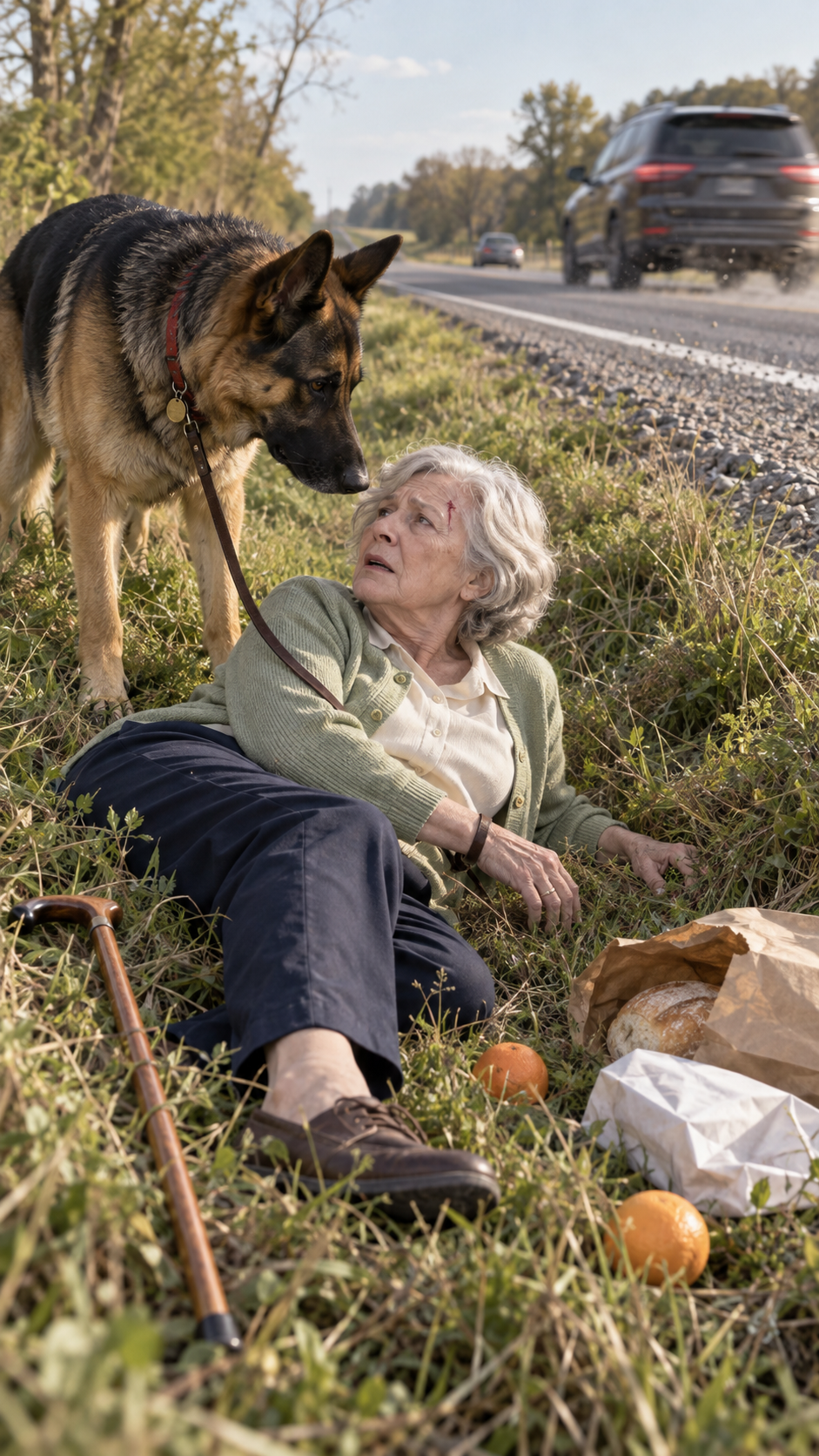
CHAPTER 4 – PART 4 – He Wouldn’t Leave Me There
PART 4: What They Told Me Later
At the hospital, time split apart into bright lights, clipped questions, paperwork, X-rays, and the peculiar humiliation of pain managed by strangers whose kindness must remain efficient.
I had a fractured hip, three cracked ribs, a sprained wrist, and a deep bruise along the right side of my head that looked worse than it was.
“Lucky,” the emergency doctor called me.
The word felt absurd lying in a hospital bed with monitors attached to my chest, but I knew what he meant.
Lucky the hip was fractured and not shattered.
Lucky the head wound had missed the temple.
Lucky the roadside ditch had grass and not concrete.
Lucky help had come.
Lucky my dog had decided the world was not allowed to lose me that day.
They admitted me overnight for observation and scheduled surgery for the following morning to stabilize the break.
I was still in the emergency unit when Ray appeared in the doorway, cap in hand, with Max beside him on a borrowed leash.
My dog saw me before I saw him, and the sound he made then was so full of relief that every nurse in earshot smiled.
“Can he come in?” Ray asked, though Max was already halfway through the doorway.
One of the nurses laughed quietly and looked the other way with the sort of institutional mercy that should be written into law.
Max came straight to the side of my bed and rested his head carefully on the blanket near my hand.
His entire body trembled.
“So you came back,” I whispered.
Ray pulled up a chair.
“Told you I would.”
He looked different out of the roadside urgency, older than I first thought, with sun-cut lines around his eyes and the weathered patience of a man who had spent his life fixing things that break outside.
“Marisol wanted to come too,” he said, “but she had to pick up her kids from school, so she asked me to tell you she’ll visit tomorrow if they let her.”
The sheer fact that there was now a tomorrow full of visits nearly overwhelmed me.
“Please thank her for me.”
“I will.”
A nurse adjusted my IV and then, because everyone in that room clearly wanted the same answer, she asked, “So how exactly did he find help?”
Ray leaned back and looked at Max as if the dog himself ought to be the one telling the story.
“Well,” he said, “I was parked at Benson’s Gas and Market because one of our crew trucks had a blown taillight, and Marisol was inside buying juice and snacks for her kids.”
Max lifted his head when he heard his name used in the conversation, then laid it down again when I scratched behind his ear.
“Suddenly he came flying into the parking lot alone,” Ray continued, “barking like his heart was on fire.”
The nurse smiled at that description.
“He went right up to Marisol first because she was near the door, and when she reached down to calm him, he grabbed the sleeve of her sweater and tugged.”
“He tugged my sleeve too,” Marisol’s voice said from the doorway.
I turned in surprise and saw her standing there, slightly out of breath, a paper coffee cup in one hand and concern written all over her face.
“I’m sorry,” she said, stepping in, “I know visiting hours aren’t really open yet, but I wanted to make sure you were all right.”
“Come in,” I said, my throat tightening again.
She was younger than I had realized at the roadside, maybe in her early thirties, with tired eyes that somehow still carried a softness untouched by fatigue.
A little girl of perhaps seven peeked from behind her legs, and a younger boy clutched her other hand.
“These are my two shadows,” Marisol said with a smile, “Lena and Mateo.”
The little girl looked solemnly at Max.
“He’s the hero dog,” she said.
Max thumped his tail once against the tile as if accepting the title with proper modesty.
Marisol sat down on the other side of the bed.
“He ran out to the parking lot, barked at me, then took off toward the road,” she said, picking up where Ray left off, “and when I followed, he’d run ahead a little, then come back to check that I was still coming.”
Ray nodded.
“He did the same with me, which is why I knew it wasn’t just a stray looking for food or attention.”
“He wasn’t frantic in a wild way,” Marisol said, “and that’s what got me, because he was scared but focused.”
That was Max in every important moment of his life.
“He led us to the shoulder,” Ray said, “then we lost sight of him for a second because of the ditch, and he actually doubled back, barked right at us, and jumped down into the grass.”
Marisol looked at me and shook her head slowly, still amazed by it.
“When I saw you there, I honestly got chills.”
I listened without interrupting because the scene they described felt both familiar and miraculous, like hearing witnesses talk about a private prayer after it has somehow become public fact.
“What if you hadn’t followed him?” I asked quietly.
Marisol’s face changed.
“I almost didn’t,” she admitted.
That answer mattered more to me than any polished version would have.
“I thought maybe he’d escaped from someone’s yard, or maybe he just wanted food, or maybe he was one of those dogs that jumps on people, and I remember thinking I didn’t really have time because I still had two pickups to make.”
She glanced down at her children.
“But he kept looking at me in this way that felt like he was begging without words, and I just… I don’t know… I followed.”
“It was the right call,” Ray said.
Marisol nodded.
“Best decision I made all week.”
We all fell quiet for a moment, and in that quiet I understood something I had not seen clearly enough before.
Max had saved me, yes, but so had every person who decided not to dismiss what was inconvenient, strange, or easy to ignore.
Loyalty had found compassion, and together they had become rescue.
The surgery went well the next morning.
Recovery did not.
The first two days afterward were a blur of nausea, pain medication, physical therapy instructions, and the humiliating helplessness of needing assistance for nearly everything.
Max could not stay in the room full-time, but Ray arranged with Donna and another neighbor to take turns caring for him, and every afternoon someone brought him to the hospital garden so I could see him from a wheelchair.
The third afternoon, when the sunlight turned the hospital brick warm and forgiving, Marisol came again with her children and a small bouquet of daisies.
“I thought you might want some real flowers after all this machinery,” she said.
I laughed for the first time since the accident.
“You have no idea how much.”
Lena brought me a crayon drawing of Max standing beside a woman in the grass with a giant red heart above both of us.
“This is you,” she said, pointing proudly.
“I knew it was,” I told her.
Mateo, who had been shy the day before, finally asked the question he had clearly been saving.
“Were you scared?”
I could have lied for his sake, but children always recognize false comfort.
“Yes,” I said, “very.”
He absorbed that and then asked, “Was Max scared too?”
“Yes,” I said again, looking out the window where Max sat beneath a dogwood tree with Ray’s hand resting on his collar, “but he did the brave thing anyway.”
That answer seemed to satisfy him.
On the fifth day, a local newspaper reporter called the hospital asking if I would comment on “the German Shepherd who rescued his owner,” because someone at the gas station had posted about it online and the story had spread.
I surprised myself by refusing.
It was not that I was ungrateful.
It was simply that some things feel smaller when turned into spectacle, and what had happened by the roadside belonged first to pain and love, not headlines.
I did allow the hospital staff to pin a handmade paper medal to Max’s collar when they brought him in that evening.
It said HERO in large blue letters with glitter around the edges.
He accepted the honor with the same solemn expression he gave pills, thunderstorms, and mail delivery.
When I laughed, the physical therapist beside me said, “He really does act like he knows.”
“Oh, he knows,” I said.
The harder truth, the one recovery gave me too much time to examine, was that I had spent years becoming smaller in my own life.
Walter’s death had narrowed my world.
Age had narrowed it further.
And somewhere along the way I had begun treating my own need as something embarrassing, as if disappearing gracefully were the last great duty of growing old.
On that roadside, Max had rejected that idea completely.
He had not left me alone because I was old.
He had not decided I was too much trouble.
He had not measured the inconvenience.
He had simply understood that I mattered.
That knowledge mended something in me medicine could not touch.
By the time I was discharged to continue rehabilitation at home, Donna had organized a schedule for meals, Ray had fixed the loose front step on my porch, and Marisol had become the kind of friend who texts before arriving but comes inside like family.
All of it had begun because one dog refused to walk away and a few strangers chose to trust what he was trying to say.
I had gone out that day expecting only bread and medicine.
I came back with a broken hip, a second chance, and proof that the world was kinder than fear had taught me to believe.
Leave a Reply