
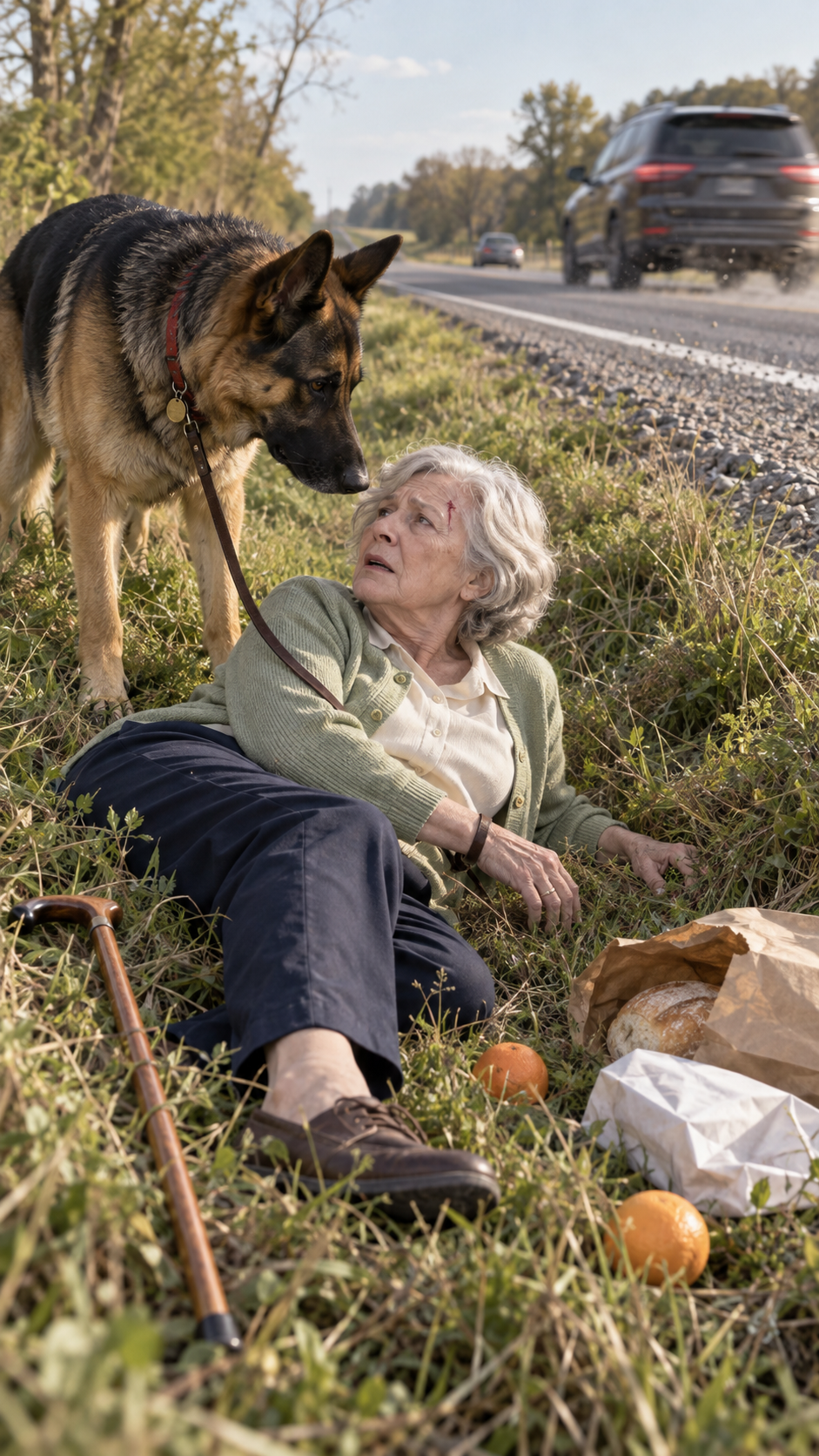
CHAPTER 3 – PART 3 – He Wouldn’t Leave Me There
PART 3: He Ran for Help
“Ma’am, can you hear me?”
The voice arrived before the face, and I turned my head enough to see a young woman kneeling in the grass with terror and determination fighting across her features.
Behind her stood a broad-shouldered man in a reflective work vest, and behind him, panting hard and whining with urgency, was Max.
“He found us,” the woman said, as if she could hardly believe the words even while speaking them.
Max shoved past her the second he saw my eyes open and pressed himself against my shoulder so hard I nearly cried out, but I would have tolerated twice the pain for the comfort of him.
“I’m here,” I said, though it came out rough and thin.
The man crouched carefully near my legs and looked from me to the road, then back again.
“My name’s Ray,” he said, his voice steady in the practical way of people who know panic helps no one, “and we’ve already called 911.”
The young woman beside him brushed hair from her face with a trembling hand.
“I’m Marisol,” she said, “and your dog nearly dragged me out of the gas station parking lot.”
Max barked once as if confirming the accuracy of the statement.
“You’re a good boy,” I whispered, and he pressed his muzzle beneath my chin so gently that the gesture felt almost reverent.
Marisol pulled off her light cardigan and folded it beneath my head with a care that made me instantly trust her.
“We didn’t want to move you,” she said, “because Ray thought your hip might be hurt.”
“It is,” I said, trying to breathe through the pain, “and my head.”
Ray gave a short nod.
“There’s blood, but it doesn’t look like a deep scalp wound,” he said, speaking more to reassure me than to diagnose anything, “and the ambulance is on the way.”
Cars were finally slowing now, though not out of kindness alone, because Ray had parked his road maintenance truck partly on the shoulder with its hazard lights flashing.
Two more people stood nearby, one older man holding a phone to his ear and another woman shading her eyes against the sun, and all of them kept glancing at Max with a kind of amazed respect.
“He came right up to us barking,” Marisol said, “then he grabbed my sleeve and pulled, and when I didn’t follow fast enough he ran a few steps away, turned around, and barked again.”
“He did the same to me,” Ray added with the hint of a disbelieving smile, “and then when I got to the roadside he started running toward this ditch and back toward me like he was saying, ‘No, not there, over here.’”
I closed my eyes for a second because the image of it struck me harder than the pain had.
No training.
No command.
No words.
Just loyalty with a body and a heartbeat.
“Did he leave her alone long?” the older man asked.
“Not more than a minute or two once we understood,” Marisol said.
Max had not yet settled, and I realized he was watching every stranger’s hand, every shift of movement, every approach toward me.
When the woman standing behind Marisol stepped closer with a bottle of water, Max gave a low warning rumble until I laid my fingers weakly against his neck.
“It’s all right,” I told him.
He quieted immediately, though his eyes stayed fixed on the stranger.
The woman unscrewed the cap and dabbed a little water onto a napkin for my lips rather than trying to make me drink, and the simple thoughtful kindness of that nearly undid me.
I had been alone in trouble for so long that I had forgotten how deeply the smallest care can reach.
“Ambulance is three minutes out,” the older man announced after ending his call.
Those three minutes felt like thirty.
The pain in my side sharpened whenever I breathed too deeply, and now that I was no longer alone, my body seemed to allow itself the luxury of shaking.
Marisol took my hand.
“You’re doing great,” she said, even though we both knew I was merely surviving, which is not at all the same thing.
“Thank you,” I told her.
“You thank him first,” Ray said, nodding toward Max.
“I intend to.”
At the sound of the approaching siren, Max stiffened.
I could feel the tension gather along his shoulders as the ambulance turned onto the road and slowed behind Ray’s truck.
Two paramedics stepped out quickly with a stretcher and medical bags, and the sight of unfamiliar uniforms pushed Max to his feet at once.
“Sir, we need the dog secured,” one of them called.
“He won’t bite if I tell him not to,” I said, though even I heard the uncertainty in my voice.
Ray crouched beside Max with his palms open and calm.
“Hey, partner,” he said softly, “you did your job.”
The words were simple, but somehow they reached him.
Max stood rigid for one more second, then backed half a step away from me without taking his eyes off the paramedics.
That was as much permission as anyone was getting.
The younger paramedic, a woman with tired eyes and a kindness-worn face, knelt beside me and introduced herself as Claire.
As she checked my pupils and felt carefully along my hip and ribs, I answered questions in the flat obedient rhythm of a patient who knows control has passed to someone else.
Name.
Evelyn Parker.
Age.
Seventy-eight.
Pain level.
Nine.
Do I know what day it is.
Yes, though the answer wavered.
Did I lose consciousness.
Maybe for a few seconds.
Any allergies.
Penicillin.
When they cut the leg of my slacks and confirmed a probable fracture, I did not cry, but when Claire said, “We’ll take good care of you,” something inside me loosened anyway.
There is a peculiar dignity in being helped when you truly need it, because it strips away every illusion that independence is the same thing as worth.
As they prepared to move me, Max began to pace again, his nails clicking nervously on the edge of the asphalt.
“I need him to come,” I said.
Claire looked uncertain.
“Animals usually can’t ride in the ambulance unless they’re certified service dogs.”
“He saved her life,” Marisol said with such force that everyone looked at her.
Ray stood up.
“I’ll bring him,” he said at once, “if that’s all right with you, ma’am.”
I turned my head toward him.
“You’d do that?”
He gave a small shrug that seemed almost embarrassed by the question.
“Your dog brought me to you,” he said, “so the least I can do is bring him to the hospital.”
That was when I finally cried.
Not loudly.
Not dramatically.
Just two exhausted tears slipping into my hair while strangers organized themselves around my pain as if compassion were the most ordinary task in the world.
They lifted me onto the stretcher with practiced care, and the pain was blinding for a moment.
Over the rush in my ears, I heard Max bark sharply.
“I’m here,” I called to him.
He fell silent at once.
When they rolled me toward the ambulance, he trotted alongside until the doors were ready to close.
His ears were high, his chest heaving, and his eyes never left mine.
“Good boy,” I whispered.
If dogs can understand love in a human voice, then he understood everything I meant.
The doors shut.
The siren started again.
And for the first time since I fell, I allowed myself to believe I was going to live.
Leave a Reply